Nutrition
How Much Sugar Per Day Is OK? Added Sugar Limits in Grams
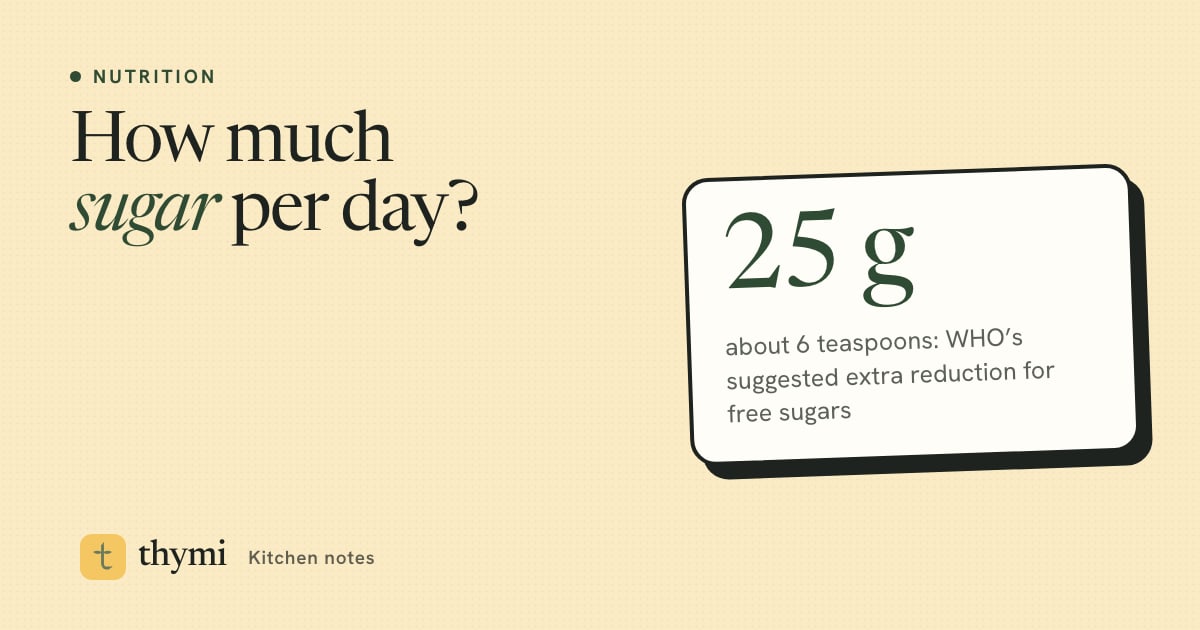
Most guidelines suggest keeping added (or “free”) sugars below 10% of your calories, which is under 50 g, or about 12 teaspoons, on a 2,000-calorie day. The WHO notes extra benefits below 5% (about 25 g, or 6 teaspoons), and the American Heart Association suggests no more than about 25 g a day for most women and 36 g for most men. Sugar naturally found in whole fruit and plain milk does not count toward these limits.
How much sugar per day: the short answer
Sugar guidelines are about added sugars: the sugar, honey, syrups and other sweeteners that get put into food and drinks. They are not about the sugar that comes packaged inside whole fruit, vegetables or plain milk. Here are the three benchmarks you will see most often:
| Source | Guidance | Grams on 2,000 kcal | Teaspoons |
|---|---|---|---|
| World Health Organization (WHO) | Free sugars below 10% of total energy | under 50 g | under ≈ 12 |
| WHO, further reduction | Below 5% of total energy for additional benefits | ≈ 25 g | ≈ 6 |
| Dietary Guidelines for Americans | Added sugars below 10% of calories | under 50 g | under ≈ 12 |
| American Heart Association, most women | No more than about 25 g a day | ≈ 25 g | ≈ 6 |
| American Heart Association, most men | No more than about 36 g a day | ≈ 36 g | ≈ 9 |
The percentage-based limits scale with how much you eat. Sugar has about 4 calories per gram, so to turn a calorie share into grams, take the percentage of your calories and divide by 4:
- 1,600 kcal: 10% = 160 kcal = 40 g. 5% = 80 kcal = 20 g.
- 2,000 kcal: 10% = 200 kcal = 50 g. 5% = 100 kcal = 25 g.
- 2,500 kcal: 10% = 250 kcal ≈ 62 g. 5% = 125 kcal ≈ 31 g.
A level teaspoon of granulated sugar weighs about 4 g and provides about 16 calories, which makes teaspoons a handy mental unit. If you are not sure how many calories you eat, our guide to how many calories you should eat a day will give you a starting estimate.
Good to know: On US Nutrition Facts labels, the Daily Value for added sugars is 50 g. So a food showing “20% DV” for added sugars contains about 10 g, roughly two and a half teaspoons.
Added sugars, free sugars and natural sugars
All sugars are chemically similar once digested, but the package they come in makes a real difference to how filling a food is and how easy it is to overdo. That is why guidelines separate them.
- Natural (intrinsic) sugars sit inside the structure of whole fruit and vegetables, or come as lactose in plain milk and yogurt. Whole fruit brings fiber, water and the need to chew, so it is hard to eat a large amount of sugar this way. These sugars are not counted toward the limits.
- Added sugars are any sugars or sweeteners added during processing, cooking or at the table: white and brown sugar, honey, maple syrup, corn syrup, jaggery, agave and so on.
- Free sugars is the WHO term. It includes all added sugars plus sugars naturally present in honey, syrups, fruit juices and fruit juice concentrates.
The main practical difference between the two terms is fruit juice. The WHO counts the sugar in juice as free sugar, while US labels do not list the sugar naturally present in 100% juice as “added”. Either way, a glass of juice is much easier to drink quickly than the several pieces of fruit it came from, so it is worth treating as a sometimes drink rather than a fruit serving.
On ingredient lists, sugar goes by many names. Common ones include sucrose, glucose, dextrose, fructose, maltose, corn syrup, high-fructose corn syrup, invert sugar, cane sugar, molasses, honey, agave nectar, rice syrup, malt syrup and fruit juice concentrate. Seeing two or three of these in one product is a clue that sugar adds up more than the first ingredient suggests.
Tip: Honey, jaggery, coconut sugar and maple syrup are less refined than white sugar and some carry tiny amounts of minerals, but they count as added or free sugars all the same. Gram for gram, their calories are similar.
Where sugar hides: drinks, sauces, cereals and yogurt
Desserts are obvious. The sugar that surprises people tends to sit in foods that do not taste especially sweet, or in drinks that go down in a few minutes. The Dietary Guidelines for Americans identify sugar-sweetened beverages as the largest single source of added sugars in the US diet.
| Food or drink (portion) | Sugar (approx.) | Teaspoons |
|---|---|---|
| Regular cola (12 fl oz / 355 ml can) | ≈ 39 g added | ≈ 10 |
| Sports drink (20 fl oz / 591 ml bottle) | ≈ 34 g added | ≈ 8.5 |
| Orange juice, 100% (1 cup / 240 ml) | ≈ 21 g free sugars | ≈ 5 |
| Chai or coffee with 2 tsp sugar (1 cup) | ≈ 8 g added | 2 |
| Ketchup (1 tbsp) | ≈ 4 g | ≈ 1 |
| Flavored yogurt (1 pot) | varies widely | check label |
| Breakfast cereal or granola (1 serving) | varies widely | check label |
A few patterns are worth knowing:
- Drinks are the big one. Soft drinks, sweetened iced tea, energy drinks, flavored coffee drinks and milkshakes can each use up most of a day’s limit, and they rarely make you feel full.
- Sauces and dressings such as ketchup, barbecue sauce, sweet chili sauce, teriyaki and some salad dressings carry a teaspoon or more per spoonful.
- Breakfast foods like flavored cereals, granola, instant oatmeal sachets, cereal bars and flavored yogurts range from almost no added sugar to several teaspoons per serving, so the label matters more than the marketing.
- “Healthy” products such as smoothies, protein bars and plant milks can be sweetened too. Unsweetened versions are usually easy to find.
How to read sugar on a nutrition label
On a US Nutrition Facts label, look under Total Carbohydrate. You will see Total Sugars and, indented below it, a line that reads “Includes X g Added Sugars” with a % Daily Value. Total Sugars includes natural sugars such as lactose and fruit sugar. The Added Sugars line is the one to compare with the guidelines.
Here is a worked example. Say a flavored yogurt lists 15 g Total Sugars and “Includes 9 g Added Sugars”. About 6 g is lactose from the milk itself. The 9 g of added sugar is a little over 2 teaspoons, and 18% of the 50 g Daily Value. That leaves plenty of room in a day, but two or three products like this plus a sweet drink would add up quickly.
Three more label habits help:
- Check the serving size first. All numbers refer to it, and a bottle or pack is often more than one serving.
- Scan the ingredient list. Ingredients are listed by weight, largest first. Several different sugars further down can still add up to a lot.
- Outside the US, many labels show only total sugars (for example “of which sugars”). Use the ingredient list and ask whether the product contains fruit or milk to judge how much is likely added.
For a full walkthrough, see how to read a nutrition facts label.
What 25 g and 50 g of added sugar look like in a day
Numbers on their own are abstract, so here are two versions of an ordinary day. The first is not unusual at all, and it shows how one drink can do most of the work.
| Day A | Added sugar (approx.) | Day B (small swaps) | Added sugar (approx.) |
|---|---|---|---|
| Sweetened cereal (label says 10 g added) | 10 g | Plain oats with sliced banana | 0 g |
| 2 cups of chai, 2 tsp sugar each | 16 g | 2 cups of chai, 1 tsp sugar each | 8 g |
| Can of cola with lunch | 39 g | Sparkling water with lime | 0 g |
| Flavored yogurt (9 g added) | 9 g | Plain yogurt with berries and 1 tsp honey | 4 g |
| Small dessert after dinner (≈ 2 tsp) | 8 g | Same small dessert, enjoyed | 8 g |
| Total | ≈ 82 g (≈ 20 tsp) | Total | ≈ 20 g (≈ 5 tsp) |
Day A is well above the 50 g benchmark, and almost half of it came from one can. Day B lands under the 25 g mark without giving up chai or dessert. The difference is also about 250 calories, which matters if you are trying to lose weight. Nothing was banned; a few defaults changed.
Practical ways to eat less added sugar without feeling deprived
You do not need to cut sugar to zero, and treating it as forbidden often backfires. These changes give the most return for the least effort:
- Start with drinks. Swap one sugary drink a day for water, sparkling water, unsweetened tea or coffee, or milk. It is usually the single biggest change you can make.
- Reduce gradually in tea and coffee. Going from two teaspoons to one and a half, then one, is easier than stopping at once. Taste preferences often adjust over a few weeks.
- Buy plain, sweeten yourself. Plain yogurt, plain oats and unsweetened cereal with fruit, cinnamon or a measured teaspoon of honey usually contain far less sugar than presweetened versions.
- Eat fruit whole. Choose an orange over orange juice. You get the fiber, and it is more filling. Our guide on how much fiber you need a day has more easy wins.
- Check two or three staples. Find the cereal, sauce and yogurt you buy most often and compare brands once. That one shopping trip pays off for months.
- Plan sweets rather than graze them. A dessert you choose and enjoy at the table is different from biscuits eaten absent-mindedly at a desk.
Low- and no-calorie sweeteners approved by the FDA can help some people move away from sugary drinks. The WHO, however, advises against relying on non-sugar sweeteners for weight control, so the longer-term aim is to get used to less sweetness overall.
Chai, mithai and festivals: sugar in Indian food
In many Indian households the biggest daily source of added sugar is not dessert but chai. Two teaspoons in each of three cups is about 24 g, already close to the WHO’s 25 g figure before anything else is eaten. Cutting to one teaspoon per cup halves that, and many people find they stop noticing within a couple of weeks.
Other common sources:
- Sweet lassi, sweetened buttermilk, nimbu pani with sugar and packaged juices. Ask for less sugar, or make them at home where you control the spoon.
- Mithai. Syrup-soaked sweets such as gulab jamun, rasgulla and jalebi, and milk-based sweets such as barfi, peda and kheer, vary a lot in sugar and calories by recipe and size. When you can, weigh a piece or log it as a specific item rather than a vague “sweet”.
- Jaggery and honey. Often seen as healthier, but they count as added sugars just like white sugar.
Festivals and weddings are meant to be enjoyed. A useful approach is to choose the sweets you really love, have a normal portion, share a box rather than finishing it, and return to your usual chai the next day. For calories in everyday dishes, see our guide to calories in Indian food.
Do you need to track sugar?
For most healthy adults, a daily sugar number is not essential. If you keep sugary drinks occasional, read the Added Sugars line on the products you buy often, and build meals around whole foods, you will usually stay within the guidelines without counting.
Tracking calories can still be revealing, because it shows what sugary foods cost in your daily budget. A can of cola is about 150 calories that rarely fill you up. In Thymi you can scan a barcode or snap a photo of a drink and see its calories and carbs land in your day. Thymi’s gauges cover calories, protein, carbs, fat and fiber rather than sugar specifically, so for added sugar the label remains your best guide. If you are new to logging, start with our guide on how to count calories.
Good to know: If you have diabetes, prediabetes or another condition that affects blood sugar, your doctor, diabetes educator or a registered dietitian can give you targets that fit your situation and medication.
Frequently asked questions
How much sugar per day is OK?
Guidelines from the WHO and the Dietary Guidelines for Americans suggest keeping added or free sugars below 10% of calories, which is under 50 g (about 12 teaspoons) on a 2,000-calorie diet. The WHO notes extra benefits below 5%, about 25 g. The American Heart Association suggests no more than about 25 g a day for most women and 36 g for most men.
Does the sugar in fruit count toward the daily limit?
No. Sugar inside whole fruit and vegetables, and the lactose in plain milk and yogurt, is not counted toward added or free sugar limits. Fruit juice is different: the WHO counts the sugar in juice as free sugar, so it is best treated as an occasional drink.
How many teaspoons of sugar is 25 grams?
About 6 teaspoons. A level teaspoon of granulated sugar weighs roughly 4 g and provides about 16 calories, so 25 g is a little over 6 teaspoons and about 100 calories.
Are honey and jaggery healthier than white sugar?
They are less refined and can contain small amounts of minerals, but they count as added or free sugars in the same way as white sugar and have a similar number of calories per gram. Use them for flavor in measured amounts rather than as a healthier substitute.
Is 50 grams of sugar a day too much?
For someone eating about 2,000 calories, 50 g of added sugar is right at the 10% upper limit used by the WHO and the US Dietary Guidelines, so it is the ceiling rather than a target. Staying closer to 25 g, the WHO’s lower figure and the American Heart Association’s suggestion for most women, leaves more room for nutritious food.
This article is general information for healthy adults, not medical or nutritional advice. Talk to a doctor or registered dietitian before changing how you eat, especially if you are pregnant or breastfeeding, have or have had an eating disorder, have a medical condition, or take medication.