Food guides
Calories in Indian Food: A Practical Guide to Common Dishes
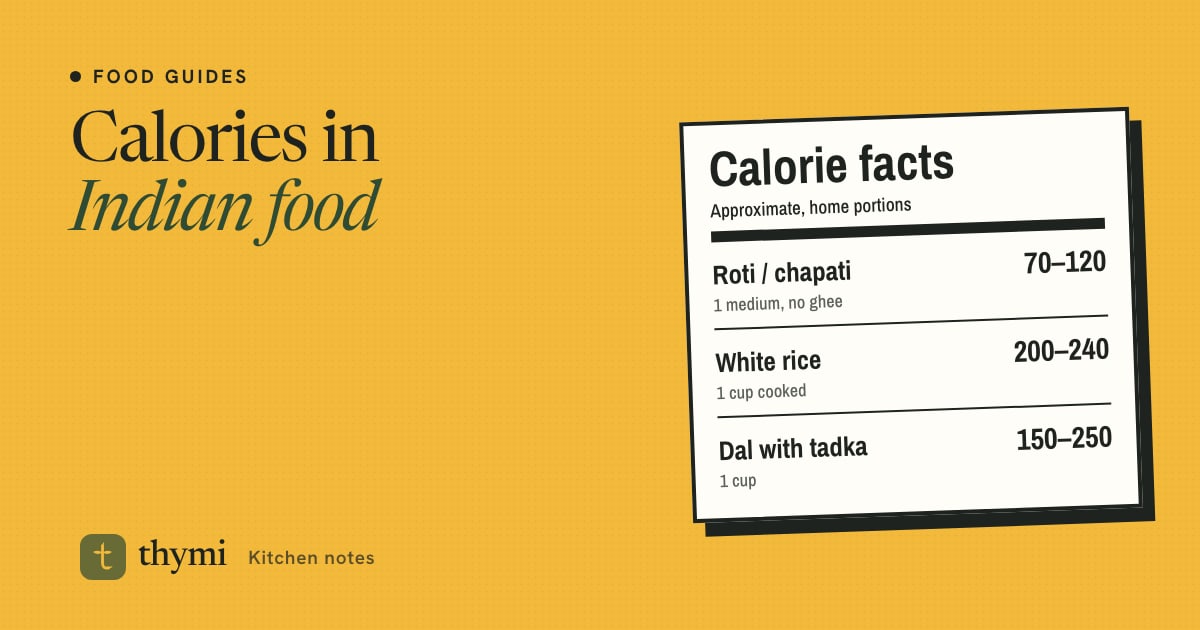
Calories in Indian food vary widely with the recipe, the portion and especially the amount of oil or ghee: a medium roti without ghee is roughly 70–120 kcal, a cup of cooked rice roughly 200–240 kcal and a cup of dal roughly 150–250 kcal. Use the chart below as a set of approximate ranges, then adjust for how your own food is cooked.
Indian food calorie chart: common dishes
Indian food isn't one cuisine. Kitchens in Punjab, Kerala, Bengal, Gujarat, Tamil Nadu, Maharashtra and everywhere in between cook very differently, and every family has its own version of dal. The chart below covers a handful of widely eaten dishes as a starting point, not a complete list.
All figures are approximate ranges for a typical home-style portion. Your own numbers depend on the recipe, how much oil or ghee goes in, and how big your serving really is.
| Food | Typical portion | Approx. calories |
|---|---|---|
| Wheat roti / chapati, no ghee | 1 medium | 70–120 |
| Aloo paratha | 1 medium | 250–350 |
| Cooked white rice | 1 cup (≈ 160 g / 5.6 oz) | 200–240 |
| Dal (cooked, with tadka) | 1 cup (≈ 200 g / 7 oz) | 150–250 |
| Rajma (kidney bean curry) | 1 cup | 200–280 |
| Plain dosa | 1 dosa | 120–200 |
| Idli | 1 idli | 40–60 |
| Chicken biryani | 1 cup | 300–450 |
| Paneer butter masala | 1 cup | 350–500 |
| Samosa (potato) | 1 medium | 250–300 |
| Gulab jamun | 1 piece | 120–180 |
| Masala chai with milk and sugar | 1 cup | 80–150 |
| Ghee or cooking oil | 1 tsp (≈ 5 g) | 40–45 |
A "cup" here means a standard measuring cup of about 240 ml (8 fl oz), loosely packed. Bowls and katoris at home are often bigger or smaller than that, which is one reason it helps to check your own dishes once.
Good to know: These ranges are general estimates for planning, not lab values. For packaged foods, the nutrition label is more reliable. For raw ingredients, databases such as the USDA's FoodData Central list values per 100 g.
Why the ranges are so wide
If you've ever looked up "calories in dal" and found answers that disagree, you're not imagining it. Three things drive most of the difference:
- Oil and ghee. Fat carries about 9 kcal per gram, compared with 4 kcal per gram for carbohydrate and protein. A dish can be mostly lentils or vegetables yet get a large share of its calories from the tadka, the tempering or the final spoon of ghee.
- The recipe. A thin, home-style moong dal and a rich dal makhani with butter and cream are both "dal", but they are very different dishes. Paneer, nuts, cream, coconut and sugar all raise the total.
- The portion. A roti can be thin and small or thick and large. A ladle of biryani might be half a cup or a cup and a half. Portion size alone can move the number by 50% or more.
That's why a single "official" number for a dish is less useful than knowing which way your version leans. If your mother's rajma uses very little oil, it sits at the lower end of the range. If you're eating at a wedding, aim for the upper end.
Oil and ghee: the biggest swing factor
One teaspoon of ghee or oil is about 40–45 kcal, and one tablespoon (three teaspoons) is about 120–135 kcal. That makes added fat the single easiest thing to get wrong when logging Indian home cooking, and the easiest place to make a difference if you want to.
How to count the tadka
The simplest method is to count the fat for the whole pot, then divide by the number of servings:
- You make dal for four people with 2 tablespoons of ghee in the tadka.
- 2 tablespoons is 6 teaspoons, so roughly 240–270 kcal from ghee in the pot.
- Divided by four, that's about 60–70 kcal of ghee in each serving, on top of the lentils themselves.
Do the same for sabzi, curries and anything shallow-fried. Count the extra spoon of ghee on the roti or rice separately, since that's added at the table.
Small changes that add up
- Measure oil with a spoon instead of pouring from the bottle, at least for a week or two, so you know what you actually use.
- Use a non-stick or well-seasoned pan, which needs less fat.
- Keep the ghee you enjoy, but be deliberate: a teaspoon on dal you love is a better use of calories than oil you don't notice.
Tip: If you cook the same dishes often, write down how much oil or ghee your usual recipe uses for the whole pot. Next time you log that dish, you already know the per-serving fat, and your estimates become much more consistent.
Roti, rice and dal: the everyday staples
Calories in roti
A medium wheat roti or chapati made without ghee is roughly 70–120 kcal, depending mostly on size and thickness. Brushing it with a teaspoon of ghee adds about 40–45 kcal. Stuffed breads such as aloo paratha are a different category: the filling and the fat used for cooking put a typical one at roughly 250–350 kcal.
Calories in rice
A cup of cooked white rice is roughly 200–240 kcal. Because rice is easy to pile onto a plate, measuring your usual serving once with a measuring cup is worth the thirty seconds. Jeera rice, pulao and fried rice add oil or ghee on top.
Calories in dal
A cup (about 200 g / 7 oz) of cooked dal is roughly 150–250 kcal, with the tadka making most of the difference. Dal is also a useful source of protein and fibre, especially in vegetarian meals, which makes it a filling choice for the calories.
Biryani, curries, snacks and sweets
Calories in biryani
A cup of chicken biryani is roughly 300–450 kcal. Biryani combines rice, meat, oil or ghee and sometimes fried onions, so both the portion and the richness vary a lot. Restaurant and celebration biryani tends towards the higher end. Raita on the side adds relatively few calories if it's made with plain curd.
Rich curries
Paneer butter masala sits at roughly 350–500 kcal per cup, because paneer, butter and cream are all energy-dense. Dishes described as makhani, malai or korma generally follow a similar pattern. Tomato- or onion-based curries with less cream usually come in lower.
Snacks and sweets
A samosa is roughly 250–300 kcal, mostly from the pastry and deep-frying. A gulab jamun is roughly 120–180 kcal, from frying and sugar syrup. Masala chai with milk and sugar is roughly 80–150 kcal a cup, which matters if you have several a day. None of these need to be off-limits. They're simply worth logging, including the second chai.
Protein-forward Indian choices
Many traditional Indian meals are built around grains, which can make it harder to reach a protein target, especially on a vegetarian diet. A few easy ways to lean in:
- Make dal, rajma, chole or sambar a bigger part of the plate, rather than a small side to a large mound of rice.
- Add curd (dahi) or raita to lunch or dinner. Plain, thick curd is a simple protein boost.
- Use paneer or tofu in bhurji, tikka or sabzi. Paneer is energy-dense, so watch the portion; tofu is a lighter option.
- Include eggs, chicken or fish if you eat them, ideally grilled, tandoori-style or in a lighter curry.
- Try besan chilla, sprouts or moong salads for breakfast or snacks.
If you're not sure how much protein you need, our guide to daily protein needs explains common targets, and how to count macros shows how to balance protein, carbs and fat.
How to log a thali or mixed plate
A thali can have six or more items, which makes it feel impossible to track. It's much easier if you log it component by component:
- List what's on the plate: for example 2 rotis, 1 katori dal, 1 katori sabzi, a small mound of rice, curd, pickle and a sweet.
- Estimate each portion. A katori often holds somewhere between half a cup and a cup, but sizes vary, so check yours once with a measuring cup. Our guide to estimating portions without a scale has more visual references.
- Add the fat you can see, such as ghee on the rice or rotis.
- Don't skip the small things. Pickle, papad, chutney and a sweet are small individually but add up.
- Save your regular meals. Most people rotate a few familiar dishes, so after a week or two logging becomes much faster.
In Thymi you can photograph the thali or simply type a description like "a plate of rajma chawal with a katori of curd", then use Fix it to adjust in plain words, for example "only one roti, and no ghee". Vegetarian and vegan diet styles are available if you set up your targets around them.
Home cooking vs restaurant Indian food
The same dish can be quite different at home and in a restaurant. Restaurant and takeaway kitchens often use more oil, butter and cream for richness, serve larger portions, and add extras like naan brushed with butter.
- At home, you know the recipe, so you can count the oil for the pot and log accurately. Lower ends of the ranges above are more likely.
- At a restaurant, assume the upper end of the range, or log a slightly larger portion to account for extra fat. Tandoori dishes, dal and dry sabzis are often lighter options than cream-based curries.
- At weddings and festivals, enjoy the food. Log your best estimate and move on; one generous meal doesn't undo weeks of consistency.
For more on handling restaurant meals of any cuisine, see our guide to tracking calories when eating out.
Frequently asked questions
How many calories are in one roti?
A medium wheat roti or chapati made without ghee is roughly 70 to 120 kcal, depending mainly on its size and thickness. Adding a teaspoon of ghee adds about 40 to 45 kcal.
How many calories are in a bowl of dal?
A cup (about 200 g) of cooked dal is roughly 150 to 250 kcal. The type of lentil matters less than the tadka: the more oil or ghee used, the closer it gets to the top of the range or beyond.
How many calories are in chicken biryani?
A cup of chicken biryani is roughly 300 to 450 kcal. Restaurant and celebration biryani is often richer, with more ghee or oil and fried onions, so it tends to sit at the upper end of that range.
Is Indian food good for weight loss?
Indian food can fit well into weight loss. Many dishes are built on lentils, beans, vegetables and curd, which are filling and nutritious. Keeping an eye on oil and ghee, portion sizes of rice and breads, and fried snacks and sweets usually makes the biggest difference.
How do I count calories in a thali?
Log each item separately: the rotis or rice, each katori of dal or sabzi, curd, pickle, papad and any sweet. Estimate portions by comparing your katori with a measuring cup once, and add any ghee you can see on top.
How many calories are in a teaspoon of ghee?
A teaspoon of ghee, about 5 g, is roughly 40 to 45 kcal. A tablespoon, which is three teaspoons, is roughly 120 to 135 kcal.
This article is general information for healthy adults, not medical or nutritional advice. Talk to a doctor or registered dietitian before changing how you eat, especially if you are pregnant or breastfeeding, have or have had an eating disorder, have a medical condition, or take medication.