Tracking
How to Track Calories When Eating Out
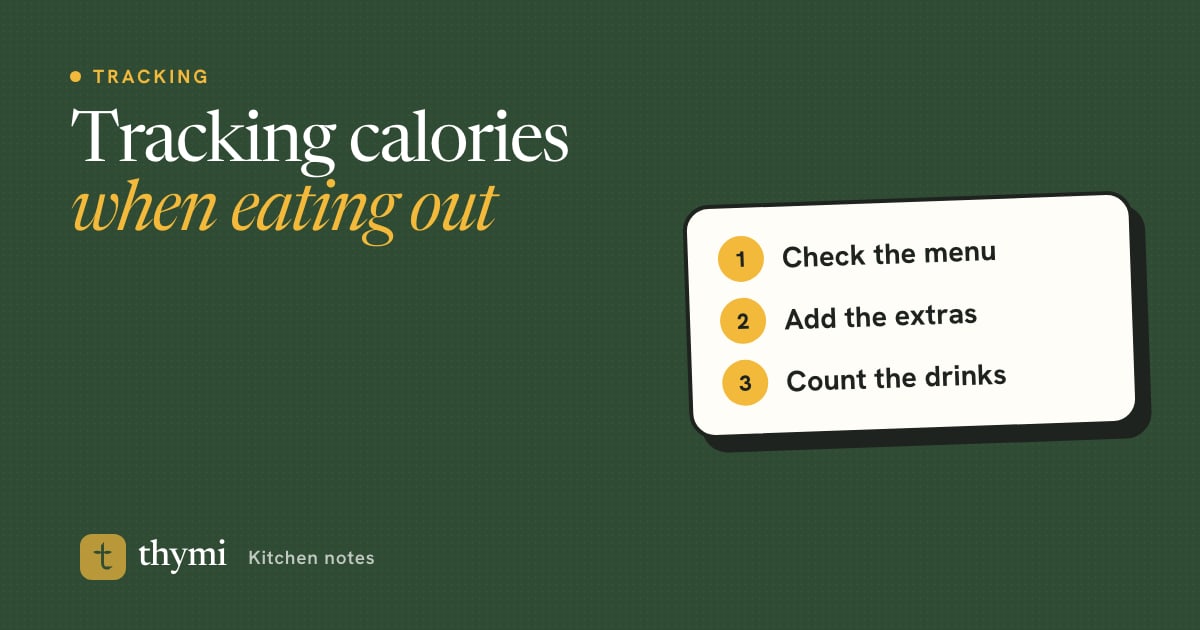
To track calories when eating out, check whether the restaurant publishes nutrition information, and if it doesn't, log the closest match you can find, broken into its parts. Then add the extras people forget, such as cooking oil, sauces, sides and drinks, and plan the rest of your day around the meal instead of skipping the log.
Why restaurant meals are harder to track
At home you can see the oil go into the pan and the rice go onto the plate. At a restaurant, you only see the finished dish. That gap is where most of the uncertainty lives.
Restaurant and takeaway food tends to differ from home cooking in a few predictable ways:
- More fat. Kitchens often use generous amounts of oil, butter and cream because they make food taste richer. Fat carries 9 kcal per gram, more than twice the 4 kcal per gram in protein or carbohydrate, so a little extra adds up quickly.
- Bigger portions. A single restaurant serving of pasta, rice or noodles is often more than you would serve yourself at home.
- Extras you don't count as food. Bread before the meal, a side of fries, a dipping sauce, a sweet drink.
- No label. Unless the restaurant publishes nutrition information, you are working from an estimate.
None of this means eating out has to derail your goals. It just means the aim shifts from "perfectly accurate" to "reasonably close and consistent". A sensible estimate logged every time beats a perfect number you never record.
Check for published menu nutrition first
The easiest restaurant meal to track is one where someone has already done the maths. Many larger chains publish calories and often full nutrition information on their menus, websites or apps. In the US, chain restaurants above a certain size are required to show calories on their menus, and similar rules exist in some other countries. Smaller independent places usually don't publish anything.
When published numbers exist, use them:
- Look up the menu before you go, while you are not hungry, and pick a couple of options that fit your day.
- Check what the number covers. Some figures are for the dish only, without sides, dressing or sauce.
- Note customisations. Adding cheese, swapping fries for a salad or asking for extra sauce all change the total.
Published figures are still estimates, because a cook's hand varies from plate to plate. But they are a much better starting point than a guess, and they help you learn what typical dishes cost so your future guesses improve. If you are unsure how to read the numbers, our guide to reading a nutrition facts label covers serving sizes and what each line means.
Log the closest match when there's no data
At an independent restaurant, a friend's house or a street food stall, there is no label to check. The practical answer is to log the closest reasonable match and move on.
Break the dish into parts
A plate of food is usually a few components: a protein, a starch, vegetables, and a fat or sauce. Log each part separately when you can. "Grilled salmon, about the size of my palm; a cup of rice; a side of buttery green beans" is easier to estimate than "salmon dinner".
Estimate portions with your hands
You won't have a food scale at the table, so use visual references. A clenched fist is roughly a cup, a palm is roughly a standard portion of meat or fish, and a thumb is roughly a tablespoon. Our guide to estimating portion sizes without a scale goes through these references in detail.
Round up slightly
Because restaurant food usually contains more fat than the home-cooked version in a database, many people find it helps to pick the more generous entry or add a little extra for cooking fat. It is not about punishing yourself; it simply corrects for a bias that tends to run in one direction.
Tip: Take a photo before you start eating, even if you log later. A picture is far more reliable than your memory of portion sizes three hours afterwards.
Account for oils, sauces and sides
The main ingredients of a meal are usually easy to spot. The extras are where calories quietly accumulate. The figures below are approximate, typical ranges; actual amounts vary by recipe and by how heavy-handed the kitchen is.
| Extra | Typical amount | Approx. calories |
|---|---|---|
| Cooking oil (any type) | 1 tbsp (15 ml) | ≈ 120 |
| Butter | 1 tbsp (14 g / 0.5 oz) | ≈ 100 |
| Mayonnaise | 1 tbsp (15 g) | ≈ 90–100 |
| Creamy salad dressing | 2 tbsp (30 ml) | ≈ 120–160 |
| Ketchup | 1 tbsp (15 g) | ≈ 15–20 |
| Bread roll with butter | 1 roll + 1 pat | ≈ 150–250 |
A few habits make these easier to manage without making a fuss:
- Ask for sauces and dressings on the side. You then control how much goes on, and you can see what you used.
- Notice how food is cooked. Grilled, steamed, baked or roasted dishes generally carry less added fat than fried, crispy, creamy or "buttery" ones.
- Log the sides. Fries, garlic bread, coleslaw and the bread basket are real food. Count what you actually ate, even if it was "just a few".
- Add a cooking fat line. If a dish looks glossy or sits in oil, add a teaspoon or a tablespoon of oil to your log as an honest correction.
Don't forget drinks and alcohol
Drinks are the easiest part of a meal out to forget, and they can add as much as a starter. Sugary soft drinks, juices, milkshakes and sweetened coffees all count, and refills make the total harder to judge.
Alcohol has its own energy value: about 7 kcal per gram, on top of any sugar in the drink. Approximate values for common drinks:
| Drink | Serving | Approx. calories |
|---|---|---|
| Regular beer or lager | 12 fl oz (355 ml) | ≈ 140–160 |
| Light beer | 12 fl oz (355 ml) | ≈ 90–110 |
| Red or white wine | 5 fl oz (150 ml) | ≈ 120–130 |
| Spirits, 40% ABV, neat | 1.5 fl oz (44 ml) | ≈ 95–100 |
| Regular cola | 12 fl oz (355 ml) | ≈ 140–150 |
Cocktails vary enormously, because syrups, juices and cream liqueurs can add far more than the spirit itself. Pub and restaurant pours are also often larger than the standard servings above. If you are not sure, log the drink by type and size and accept that it is an estimate.
Alcohol can also loosen your resolve around the rest of the menu. That is not a reason for guilt, just something worth knowing when you plan.
Use the half-portion and box-it strategies
Restaurant portions are often generous, which gives you a simple lever: you don't have to finish the plate.
- Box half at the start. Ask for a takeaway container with your meal and set half aside before you begin. It is easier than stopping halfway.
- Share a starter or dessert. You get the taste without the full portion.
- Order a starter as a main, or a smaller size where one is offered.
- Fill up on protein and vegetables first. A meal built around a lean protein and a vegetable side tends to be filling for fewer calories than one built around fried sides.
When you eat half, log half. If you log the full published value but only eat 60% of it, the numbers in your diary stop reflecting reality, and that makes it harder to learn from your data.
Plan the rest of your day around it
One restaurant meal is a small part of a week. The most effective approach is usually to plan around it rather than try to undo it afterwards.
- Pre-log the meal. If you know where you're going, log your likely order in the morning. You can then see what's left for breakfast and lunch.
- Keep earlier meals lighter but not tiny. A protein-rich breakfast and lunch with plenty of vegetables leaves room for dinner without arriving starving, which tends to lead to over-ordering.
- Think in weeks, not days. If your daily budget is set for a modest calorie deficit, a single higher day barely shifts your weekly average.
- Don't "make up" for it with a crash day. Eating very little the next day often backfires with hunger later. Return to your usual plan instead.
Good to know: The scale may jump the morning after a restaurant meal. Salty, carb-heavy food makes your body hold extra water, so much of that jump is temporary. Our guide to why your weight fluctuates day to day explains why.
Why you shouldn't skip tracking (and how to keep it quick)
It's tempting to treat meals out as "off the record". The problem is that those are often the higher-calorie meals of the week, so skipping them leaves the biggest blind spot exactly where it matters most. If the scale isn't moving as expected, the unlogged meals are usually the first place to look.
Tracking a restaurant meal doesn't have to be a production at the table:
- Snap a photo when the food arrives.
- Log it later in a minute or two, breaking it into parts and adding drinks and sides.
- Accept a sensible estimate and move on with your evening.
Apps can make this faster. In Thymi you can photograph the plate and let the AI identify the foods and estimate portions, or simply type a description such as "half a chicken burger, a small fries and a pint of lager". If something looks off, "Fix it" lets you correct the entry in plain words, like "the fries were a large". Each item is marked Verified or Estimated, so you know which numbers to treat with more caution. If you are curious how reliable photo-based logging is, see our explainer on how accurate AI calorie counters are.
The goal is not perfection. A consistent, honest estimate for every meal, including the fun ones, is what makes your data useful over weeks and months.
Frequently asked questions
How do I count calories at a restaurant with no nutrition information?
Break the meal into its parts, such as the protein, the starch, the vegetables and the sauce, estimate each portion using visual references like your fist or palm, and log the closest match for each. Add a little extra for cooking oil or butter, since restaurant food usually contains more fat than home cooking.
Are calories on restaurant menus accurate?
Published menu calories are a good starting point, but they are still estimates. Portions and the amount of oil or sauce vary from plate to plate, so the real number can be somewhat higher or lower. They are far more reliable than guessing with no information at all.
How many calories should I add for cooking oil when eating out?
One tablespoon of oil is about 120 kcal and one teaspoon is about 40 kcal. If a dish looks glossy, fried or sits in oil, adding a teaspoon or a tablespoon of oil to your log is a reasonable correction.
Should I skip tracking when I eat out?
It is better not to. Restaurant meals are often among the highest-calorie meals of the week, so leaving them out creates the biggest gap in your food diary. A quick, honest estimate is much more useful than no entry.
How do I fit a restaurant meal into a calorie deficit?
Look at the menu in advance, pre-log your likely order, and keep breakfast and lunch protein-rich but a little lighter. Think of your intake across the whole week rather than one day, and return to your normal plan the next day rather than eating very little to compensate.
How many calories are in takeaway food?
It depends heavily on the dish, the portion and how it is cooked. Fried dishes, creamy sauces and large portions of rice or noodles push the total up. Check the restaurant's published nutrition if it exists, and otherwise log each component separately and include the sauces and sides.
This article is general information for healthy adults, not medical or nutritional advice. Talk to a doctor or registered dietitian before changing how you eat, especially if you are pregnant or breastfeeding, have or have had an eating disorder, have a medical condition, or take medication.