Food guides
How Many Calories in a Banana? Size, Sugar and Ripeness
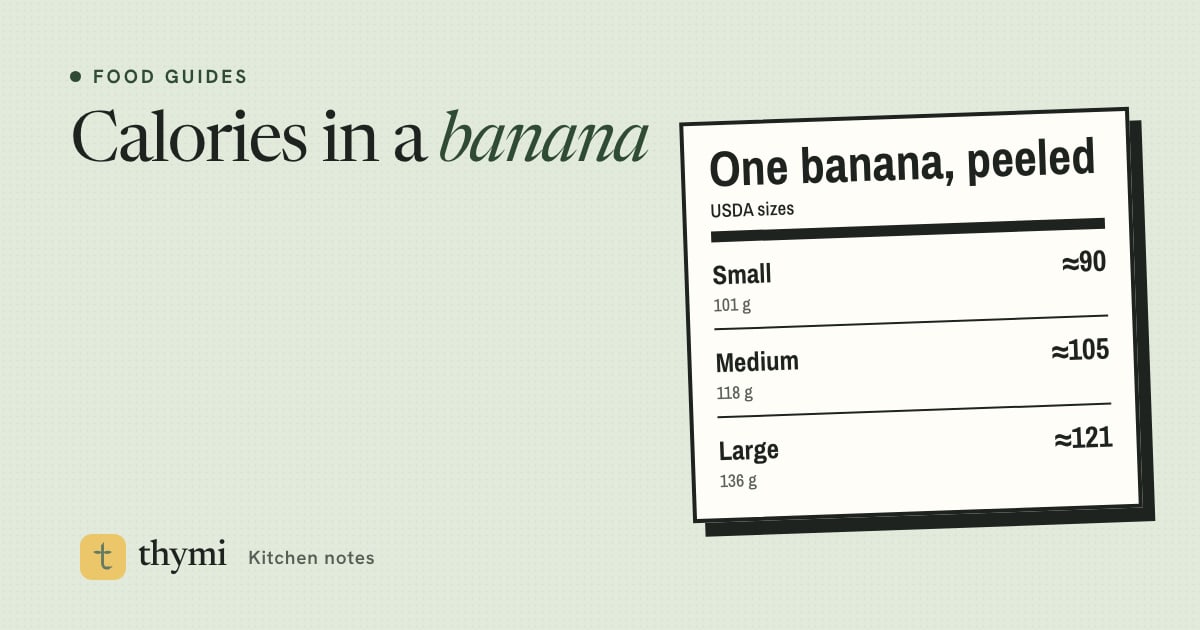
A medium banana (about 7–8 inches long, 118 g peeled) has about 105 calories, 27 g of carbohydrate, 3 g of fiber and 14 g of natural sugar, according to USDA data. A small banana is about 90 calories and a large one about 121. Per 100 g of peeled banana, it is about 89 calories, whether the banana is green or very ripe.
Banana calories by size
A banana's calories depend almost entirely on its size, because the flesh itself is very consistent: about 89 kcal per 100 g, according to USDA FoodData Central. The USDA defines banana sizes by length, measured along the outside curve, and gives a typical peeled weight for each. All the figures below are for the edible part, without the peel.
| Banana size (USDA) | Length | Peeled weight | Calories |
|---|---|---|---|
| Extra small | Under 6 in (15 cm) | ≈ 81 g | ≈ 72 |
| Small | 6–6⅞ in (15–17.5 cm) | ≈ 101 g | ≈ 90 |
| Medium | 7–7⅞ in (18–20 cm) | ≈ 118 g | ≈ 105 |
| Large | 8–8⅞ in (20–22.5 cm) | ≈ 136 g | ≈ 121 |
| Extra large | 9 in (23 cm) or longer | ≈ 152 g | ≈ 135 |
| 1 cup sliced | — | ≈ 150 g | ≈ 134 |
| 1 cup mashed | — | ≈ 225 g | ≈ 200 |
| Per 100 g | — | 100 g | ≈ 89 |
Most supermarket bananas in the US and Europe are medium to large. The small, sweet bananas common in India and Southeast Asia (elaichi or "lady finger" types) are often in the extra-small range, around 50–80 g peeled, so roughly 45–70 kcal each. Larger varieties such as Kerala's nendran are a different story and can be well over 150 g.
The peel makes up roughly a third of a banana's total weight. If you weigh a banana whole, multiply by about two thirds to estimate the peeled weight, or simply peel it first and weigh the fruit. A quick rule: peeled banana is a little under 1 kcal per gram.
Tip: If you eat bananas often, weigh a few from your usual shop once. You will quickly learn whether "a banana" in your house is small, medium or large, and you can log that size from then on without a scale. Our guide to estimating portions without a scale has more tricks like this.
Carbs, fiber, sugar and potassium
Bananas are mostly water and carbohydrate, with very little fat or protein. Here are the approximate USDA values for each size:
| Size | Carbs | Fiber | Sugar | Protein | Potassium |
|---|---|---|---|---|---|
| Extra small (81 g) | ≈ 18.5 g | ≈ 2.1 g | ≈ 10 g | ≈ 0.9 g | ≈ 290 mg |
| Small (101 g) | ≈ 23 g | ≈ 2.6 g | ≈ 12 g | ≈ 1.1 g | ≈ 362 mg |
| Medium (118 g) | ≈ 27 g | ≈ 3.1 g | ≈ 14.4 g | ≈ 1.3 g | ≈ 422 mg |
| Large (136 g) | ≈ 31 g | ≈ 3.5 g | ≈ 16.6 g | ≈ 1.5 g | ≈ 487 mg |
| Extra large (152 g) | ≈ 35 g | ≈ 4 g | ≈ 18.5 g | ≈ 1.7 g | ≈ 544 mg |
| Per 100 g | ≈ 22.8 g | ≈ 2.6 g | ≈ 12.2 g | ≈ 1.1 g | ≈ 358 mg |
A medium banana also has about 0.4 g of fat, about 0.4 mg of vitamin B6 (roughly a quarter of the daily value) and some vitamin C and magnesium.
Is the sugar in bananas a problem?
The sugar in a whole banana is naturally present in the fruit, not added, so it does not count toward the added-sugar limits in the Dietary Guidelines for Americans or on the "Added Sugars" line of a US nutrition label. It also arrives packaged with water and fiber, which is part of why a banana is more filling than the same amount of sugar in a drink. Our guide to how much sugar per day is OK explains the difference between natural and added sugar in more detail.
Potassium
Bananas are famous for potassium, and a medium one has about 422 mg, roughly 9% of the 4,700 mg daily value used on US labels. That is useful, but not unique: a cup of cooked lentils, a medium potato with skin or a cup of cooked spinach each provide as much or more. Bananas are simply an easy, portable source. If you have kidney disease or take medication that affects potassium, follow your doctor's advice on how much you should have.
Carbs and fiber
At about 27 g of carbs, a medium banana is similar to about two slices of bread. If you are counting carbs, our guide to how many carbs per day shows how fruit fits into a daily target. The 3 g of fiber is a decent start toward the roughly 25–38 g a day that US guidance works out to for most adults; see how much fiber you need per day.
Green vs ripe bananas: starch vs sugar
As a banana ripens, its carbohydrate changes form. In a green, unripe banana, most of the carbohydrate is starch, and a large share of it is resistant starch, a type that your small intestine does not fully digest and that behaves more like fiber. As the banana turns yellow and then spotty, enzymes break that starch down into sugars. A fully ripe banana's carbohydrate is mostly sugar, which is why it tastes sweeter and softer.
| Ripeness | Carbohydrate is mostly | Taste and texture |
|---|---|---|
| Green | Starch, much of it resistant starch | Firm, starchy, slightly bitter |
| Yellow with green tips | A mix of starch and sugar | Firm, mildly sweet |
| Fully yellow | Mostly sugar | Sweet, soft |
| Brown-spotted | Almost all sugar | Very sweet, soft; ideal for baking |
Does ripeness change the calories? Very little for logging purposes. The total carbohydrate stays about the same; it just changes form. Because some resistant starch in a green banana is not fully absorbed, a green banana may provide slightly fewer usable calories, but the difference is small and food databases do not separate bananas by ripeness. Log a banana by its size, whatever its color.
What ripeness can change is how a banana feels. Some people find a firmer, less ripe banana more filling and gentler on blood sugar, while very ripe bananas have a higher glycemic response. If you manage diabetes, a whole banana can usually fit into your meal plan; pairing it with protein or fat (yogurt, nuts, peanut butter) and talking to your care team about portions is the sensible route.
Good to know: Raw green bananas (kacha kela) cooked as a vegetable, in sabzi, chips or kofta, are a different food from a ripe dessert banana. Plain boiled green banana is in a similar calorie range per gram, but the oil used in cooking is what usually moves the number.
Banana chips and dried banana
Removing water concentrates everything in a banana into fewer grams, and frying adds fat on top. That is why banana chips and dried bananas are so much more calorie-dense than the fresh fruit.
| Banana product | Per 100 g | Per 1 oz (28 g) | Why |
|---|---|---|---|
| Fresh banana, peeled | ≈ 89 kcal | ≈ 25 kcal | About 75% water |
| Dried banana (dehydrated, unsweetened) | ≈ 346 kcal | ≈ 97 kcal | Water removed, sugar concentrated |
| Banana chips (fried) | ≈ 520 kcal | ≈ 147 kcal | Water removed, then fried in oil |
A small handful of fried banana chips (1 oz, 28 g) has about 147 kcal and roughly 9 g of fat, more than a large fresh banana. The Kerala-style chips fried in coconut oil and the sweetened chips sold in snack mixes are in the same broad range, around 500–550 kcal per 100 g; check the label on the pack. Serving sizes on chip packets are often smaller than what people actually eat.
Dried banana, without oil, has about 346 kcal per 100 g, so about 30 g, a small handful, is roughly the same as one medium fresh banana. It is easy to eat a lot without noticing, because the volume is so much smaller.
None of this makes chips or dried fruit off-limits. They are just energy-dense, so they are worth portioning into a bowl rather than eating from the bag. For other snack ideas with clear numbers, see our list of snacks under 200 calories.
Bananas in smoothies and shakes
A banana in a smoothie is still about 105 kcal; the rest of the glass is where the range comes from. A few common combinations, using a medium banana and approximate USDA values for the other ingredients:
| Drink | Calories (approx.) | Protein (approx.) |
|---|---|---|
| Banana + 1 cup (240 ml) unsweetened almond milk | ≈ 140 | ≈ 2.5 g |
| Banana + 1 cup 2% milk | ≈ 225 | ≈ 9 g |
| Banana shake: banana + 1 cup whole milk + 2 tsp sugar | ≈ 285 | ≈ 9 g |
| Banana + 1 cup 2% milk + 1 tbsp peanut butter | ≈ 320 | ≈ 13 g |
| Banana + 1 scoop whey protein + 1 cup 2% milk | ≈ 345–355 | ≈ 32–34 g |
| Banana + ½ cup plain Greek yogurt + ¼ cup oats + 1 tsp honey | ≈ 270–290 | ≈ 15 g |
Shop and café smoothies are often large, 16–24 oz, and can include juice, frozen yogurt, sweetened bases or several bananas, so they can easily land well above these figures. If the shop publishes nutrition information, use it.
Adding a protein source turns a banana drink from a snack into something closer to a meal. If you are looking for breakfast ideas along those lines, see our guide to high protein breakfasts.
Are bananas good for weight loss?
Bananas can fit comfortably into a weight-loss plan. At about 105 kcal, a medium banana is a modest, filling snack with fiber, potassium and some vitamins, and it needs no preparation. No single food causes weight gain or weight loss on its own; what matters is your overall calorie balance over time, as our guide to calorie deficits explains.
A few practical points:
- Bananas are not "too sugary". The natural sugar comes with fiber and water, and a whole banana is a very different thing from a sugary drink with the same carbs.
- Pairing helps. A banana with a protein or fat source, such as Greek yogurt, a boiled egg, a glass of milk or a tablespoon of peanut butter, tends to keep people full for longer than the banana alone. Our guide to foods that keep you full covers why.
- The format matters more than the fruit. A fresh banana, a handful of banana chips and a large café smoothie can range from about 105 to 500 kcal or more.
- Before or after exercise, a banana is an easy source of quick carbohydrate that many people find gentle on the stomach.
If you like bananas, there is no reason to cut them out. Choose the size that suits your day, and enjoy it.
How to log a banana quickly
Bananas are among the easiest foods to log, because the composition is so consistent:
- Pick the size. If you are unsure, medium (about 105 kcal) is a sensible default for supermarket bananas. Small local varieties are usually extra small or small.
- Or weigh it peeled and log grams: about 0.89 kcal per gram.
- Log what goes with it: peanut butter, milk, yogurt, honey or the sugar in a shake.
- For chips and dried banana, use the pack's label or weigh your portion, since these vary more between brands.
In Thymi, you can type "one large banana and a tablespoon of peanut butter", take a photo, or search the food database. Each item is matched to USDA FoodData Central or Open Food Facts and labelled Verified or Estimated, and you can adjust the grams if your banana is bigger or smaller than the default. For packaged banana chips, a barcode scan pulls the label in one go. If something is off, Fix it lets you correct it in plain words, such as "it was a small banana".
Frequently asked questions
How many calories are in a medium banana?
A medium banana, about 7 to 8 inches long and 118 g without the peel, has roughly 105 calories, 27 g of carbohydrate, 3.1 g of fiber, 14.4 g of natural sugar and 1.3 g of protein, based on USDA data.
How many calories are in 100 g of banana?
100 g of peeled raw banana has about 89 calories, 22.8 g of carbohydrate, 2.6 g of fiber and 12.2 g of sugar. That is a little under 1 calorie per gram.
Does a ripe banana have more calories than a green one?
Not in any meaningful way. As a banana ripens, its starch turns into sugar, but the total carbohydrate stays about the same. A green banana may provide slightly fewer usable calories because some of its resistant starch is not fully digested, but for logging, use the same values for any ripeness.
How many calories are in banana chips?
Fried banana chips have about 520 calories per 100 g, or roughly 147 calories per 1 oz (28 g) handful, because the water is removed and the chips absorb oil during frying. Check the pack, as brands vary.
Are bananas good for weight loss?
Bananas can fit well into a weight-loss plan. A medium banana is about 105 calories with fiber and potassium, and pairing it with a protein such as yogurt or peanut butter makes it more filling. Weight loss depends on your overall calories, not on any single food.
This article is general information for healthy adults, not medical or nutritional advice. Talk to a doctor or registered dietitian before changing how you eat, especially if you are pregnant or breastfeeding, have or have had an eating disorder, have a medical condition, or take medication.