Macros
How Much Protein Can Your Body Absorb in One Meal?
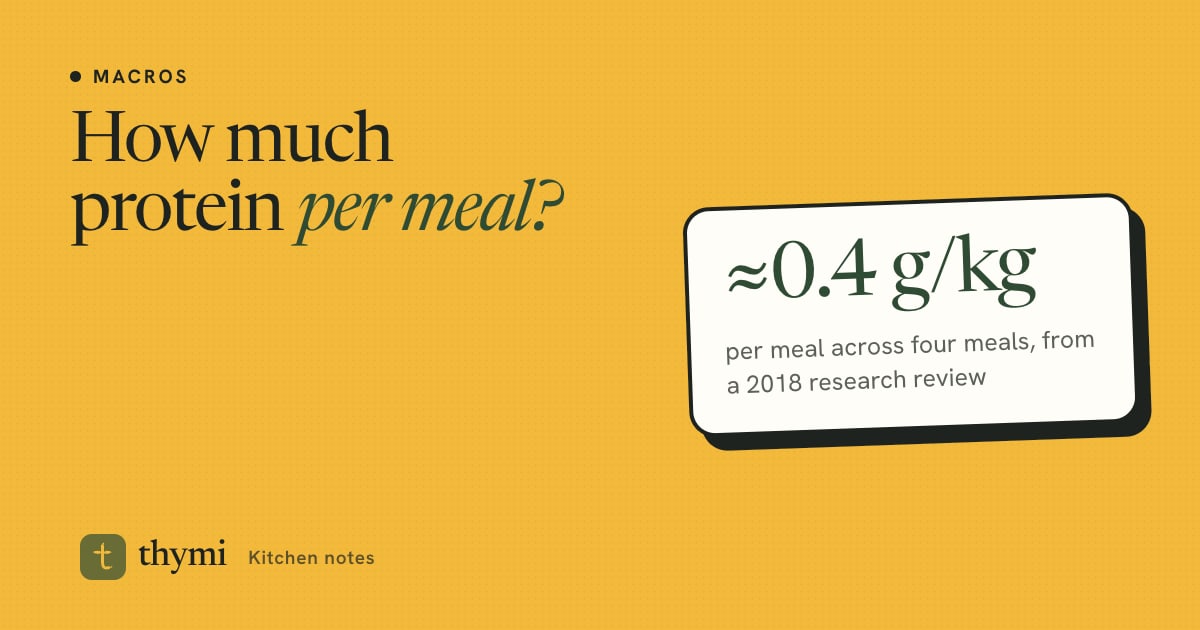
Your body absorbs nearly all the protein you eat, whether it arrives in 20 g or 100 g; there is no 30 g cut-off where the rest is wasted. What changes with bigger doses is how fast it is used and how much goes to muscle at once. For most people, a practical target is about 0.4 g of protein per kg of body weight per meal (roughly 25–40 g for many adults) across three or four meals, which reaches the daily total without forcing huge portions.
The "30 grams per meal" myth
Gym lore has said for years that your body can only "absorb" 20–30 g of protein at a time, and anything more is wasted. The idea grew out of real studies, but it mixes up two different things: absorption and muscle protein synthesis.
Absorption means protein is digested into amino acids and taken up from the gut into the blood. In healthy people that is extremely efficient. As a 2018 review in the Journal of the International Society of Sports Nutrition by Schoenfeld and Aragon put it, the amount of protein that can be absorbed is virtually unlimited under the standard definition of absorption. A large meal simply takes longer to digest.
The better question is how much of a single meal's protein your muscles can use for building and repair in the hours afterwards, and what happens to the rest.
What the research actually shows
The 20–30 g figure comes from studies in young, trained men after resistance exercise. In a well-known 2009 study, 20 g of egg protein after leg exercise produced close to the maximum rise in muscle protein synthesis, with 40 g adding little extra for muscle and more amino acids being burned for energy. Later work challenged the ceiling: a 2016 study found 40 g of whey produced a larger response than 20 g after a whole-body workout, suggesting the amount of muscle trained matters.
The biggest shake-up came from a 2023 study in Cell Reports Medicine by Trommelen and colleagues. Healthy young men did a resistance workout and then drank either 25 g or 100 g of milk protein (or a placebo). The 100 g dose produced a larger and much longer anabolic response, lasting more than 12 hours, than 25 g. The authors concluded that the response to protein has no clear upper limit in size or duration.
A few caveats keep this in perspective:
- It was one study, in young men, after exercise, using slow-digesting milk protein.
- Only a fraction of any protein dose ends up in muscle within 12 hours; the rest supports other tissues, is used for energy or is processed over a longer period.
- It doesn't show that one 100 g meal is better than the same protein split across the day. It shows a big meal isn't simply wasted.
A practical per-meal target
Schoenfeld and Aragon's review turned the research into a simple guide for people trying to build or keep muscle: about 0.4 g per kg of body weight per meal, across at least four meals, to reach at least 1.6 g per kg a day. They suggested an upper end of about 0.55 g per kg per meal, reaching about 2.2 g per kg a day.
| Body weight | 0.4 g/kg per meal | × 4 meals |
|---|---|---|
| 55 kg (121 lb) | ≈ 22 g | ≈ 88 g |
| 65 kg (143 lb) | ≈ 26 g | ≈ 104 g |
| 75 kg (165 lb) | ≈ 30 g | ≈ 120 g |
| 90 kg (198 lb) | ≈ 36 g | ≈ 144 g |
These figures are aimed at people who lift weights or want to maximise muscle. If you are not training, your daily need is lower; the general adult recommended daily allowance is 0.8 g per kg. Our guide to how much protein you need a day covers the ranges for different goals. If you have kidney disease, check with your doctor before raising protein.
Why spreading protein still makes sense
If big meals aren't wasted, why bother splitting protein up? A few practical reasons:
- It's easier to hit the daily total. Eating 120 g in one sitting is unpleasant for most people. Four portions of 30 g is a normal amount of food.
- Many people front-load carbs and back-load protein. A typical day might be cereal for breakfast, a sandwich for lunch and most of the protein at dinner. Moving some protein earlier fixes the imbalance.
- Protein helps you feel full. A protein-led breakfast or lunch can make the afternoon snack attack less likely. Our guide to foods that keep you full explains why.
- It suits real life. If you only eat twice a day, for example with intermittent fasting, larger protein portions at those meals are fine. Total intake matters most.
What 25–40 g of protein looks like
Approximate amounts in common meals and portions. Values vary by brand and preparation.
| Meal or portion | Approx. protein |
|---|---|
| 3 large eggs + 1 cup milk | ≈ 27 g |
| 250 g plain non-fat Greek yogurt + 2 tbsp nuts | ≈ 28–30 g |
| 120 g cooked chicken breast | ≈ 37 g |
| 1 can tuna (≈ 140 g drained) on toast | ≈ 35 g |
| 150 g cooked salmon | ≈ 33–37 g |
| 200 g firm tofu stir-fry | ≈ 20–34 g |
| 1½ cups cooked lentils | ≈ 27 g |
| 1 scoop whey protein in milk | ≈ 28–33 g |
For more meal ideas built around these numbers, see our 7-day high-protein meal plan and high-protein breakfast ideas.
Does timing around workouts matter?
Less than supplement adverts suggest. The idea of a narrow 30-minute "anabolic window" after training has softened over the years: muscles stay more sensitive to protein for many hours after a session. If you eat a protein-containing meal within a few hours before or after training, you have covered it. A shake straight after the gym is convenient, not essential.
What matters far more is reaching your daily protein total most days and training consistently. If you train in the evening, making dinner your largest protein meal is perfectly reasonable. If you train first thing, a protein-led breakfast does the same job. Pick the pattern that fits your day and your appetite.
Who may need more per meal
Older adults. Research suggests older muscles are less responsive to protein, so they may need a larger dose per meal to get the same response as younger people. Including a solid protein portion at every meal is especially worthwhile with age.
Plant-based eaters. Some plant proteins are digested a little less completely and contain less of the amino acid leucine. A slightly bigger portion, or mixing sources such as soy, lentils and grains, covers it. See our list of vegetarian protein sources.
People losing weight. A calorie deficit raises the risk of losing muscle along with fat, which is why higher protein and strength training are common advice during weight loss. People taking GLP-1 medicines face the same issue with a smaller appetite; see protein on a GLP-1.
How to check your per-meal protein
Most people guess their protein badly, usually overestimating breakfast and lunch. Logging for a week shows where the gaps are. A good tracker shows protein per meal, not just the day's total, so you can see at a glance that breakfast had 8 g and dinner had 60 g.
Thymi shows protein, carbs and fat for every meal alongside your daily targets. Snap a photo, scan a barcode or type "two eggs and toast", and the numbers fill in. Thymi is free on the App Store for iPhone and Google Play for Android. If you are new to macros, our guide to counting macros is a good place to start.
Sources
- Schoenfeld BJ, Aragon AA. How much protein can the body use in a single meal for muscle-building? Implications for daily protein distribution. J Int Soc Sports Nutr, 2018.
- Trommelen J, et al. The anabolic response to protein ingestion during recovery from exercise has no upper limit in magnitude and duration in vivo in humans. Cell Reports Medicine, 2023.
- Moore DR, et al. Ingested protein dose response of muscle and albumin protein synthesis after resistance exercise in young men. Am J Clin Nutr, 2009.
- Macnaughton LS, et al. The response of muscle protein synthesis following whole-body resistance exercise is greater following 40 g than 20 g of ingested whey protein. Physiol Rep, 2016.
Frequently asked questions
Can your body only absorb 30 g of protein at once?
No. Healthy people absorb nearly all the protein they eat; larger amounts just take longer to digest. The 20–30 g figure came from studies on how much protein maximally stimulates muscle building after exercise, and newer research suggests even that is not a hard limit.
Is eating 50 g of protein in one meal a waste?
No. A 2023 study found 100 g of protein after exercise produced a larger and longer muscle-building response than 25 g. Some protein is used for energy or other tissues, but it is not simply wasted. Total daily protein matters most.
How much protein should I eat per meal?
A practical target from a 2018 review is about 0.4 g per kg of body weight per meal across at least four meals, which is roughly 25–40 g for many adults. If you are not trying to build muscle, smaller amounts that add up to your daily target are fine.
Is it better to eat protein in several meals or one?
Spreading protein across three or four meals makes a higher daily target easier to reach and may suit muscle building, but the evidence shows larger single meals are still used. Choose the pattern you can stick to.
Do older adults need more protein per meal?
Research suggests older muscles respond less to small doses of protein, so older adults may benefit from a larger protein portion at each meal. Anyone with kidney disease should check with a doctor before increasing protein.
This article is general information for healthy adults, not medical or nutritional advice. Talk to a doctor or registered dietitian before changing how you eat, especially if you have kidney disease or another medical condition, are pregnant or breastfeeding, or have or have had an eating disorder.