Meal planning
1,800 Calorie Meal Plan: 7 Days of High Protein Meals + Grocery List
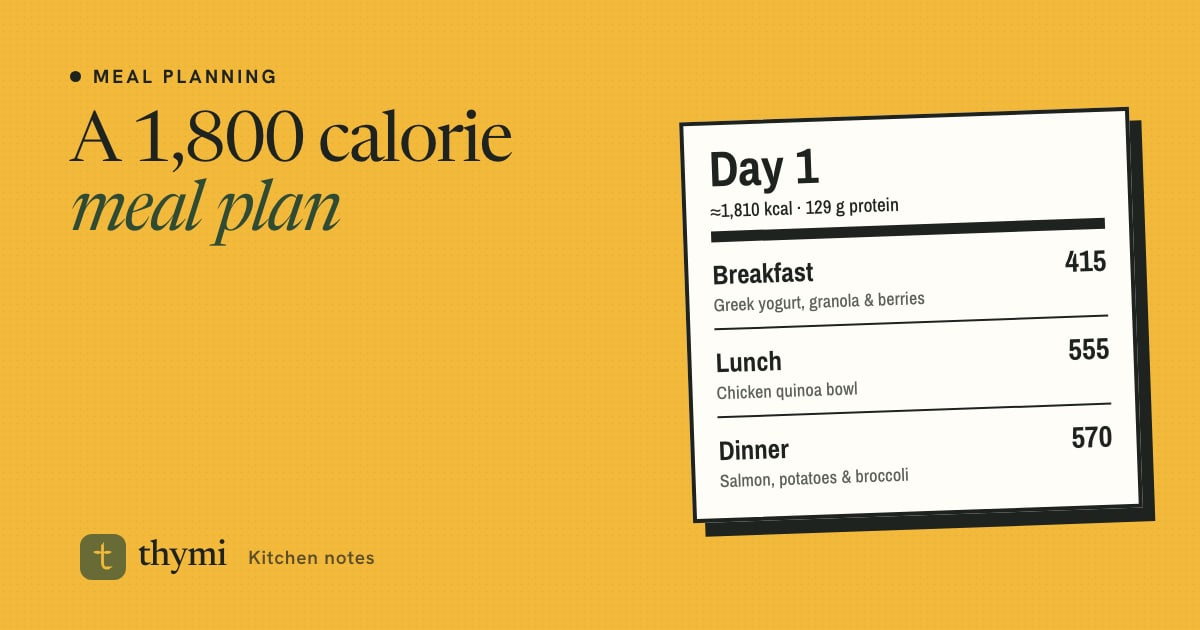
A good 1,800 calorie meal plan gives you about 400 calories at breakfast, 550 at lunch, 600 at dinner and a 200 to 300 calorie snack, with 120 to 140 g of protein spread across the day so you stay full. The 7-day plan below does exactly that with ordinary supermarket food: every meal has its approximate calories and protein, each day lands between about 1,775 and 1,825 kcal, and a grocery list and swaps follow. It suits many women as a gentle deficit or maintenance and many men as a modest deficit, so check your own number first.
Who an 1,800 calorie meal plan suits
1,800 calories sits in a useful middle ground. It is enough food to eat three proper meals and a real snack, and it is low enough to create a deficit for a lot of people. Whether it is right for you depends on how much energy you burn, which comes down to size, age, sex and activity.
The estimated calorie needs published with the Dietary Guidelines for Americans give a feel for where 1,800 lands:
- Maintenance for many women. The estimates put many sedentary women aged about 26 to 50, and many moderately active women in their fifties, at around 1,800 calories a day. For them this plan is a way to eat well without losing or gaining.
- A moderate deficit for many active women and most men. Moderately active women in their twenties to forties are estimated at about 2,000 to 2,200 calories, and sedentary men at about 2,000 to 2,400. For them, 1,800 is a deficit of roughly 200 to 600 calories a day, which is a sustainable pace.
- Too much for some. If you are smaller or mostly sedentary and want to lose weight, a 1,500 calorie meal plan may fit better.
- Too little for others. Tall, young or very active people, especially men who train hard, often maintain on 2,600 calories or more. For them our 2,000 calorie meal plan is a more comfortable starting point.
If you are not sure where you fall, start with our guide to how many calories you should eat a day, then read how big a calorie deficit should be. A deficit of about 300 to 500 calories a day is a common, comfortable choice.
Good to know: this plan is an example for healthy adults, not a prescription. If you are pregnant or breastfeeding, have a medical condition, take medication that affects appetite or blood sugar, or have a history of disordered eating, talk to a doctor or registered dietitian before following any calorie target.
How this 1,800 calorie meal plan is built
Every day follows the same few rules, so you can swap meals between days and still land close to 1,800:
- About 130 g of protein a day. That is roughly 29% of calories, comfortably inside the 10 to 35% range the Dietary Guidelines suggest. Each main meal carries 25 to 50 g, rather than saving it all for dinner. See how much protein you need a day to check your own range.
- Carbs you can see. Oats, whole-grain bread, rice, quinoa, potatoes, beans and fruit, in measured portions, so the plan fuels a workout and does not feel like a diet.
- Measured fats. Oil, nut butter, nuts, cheese and avocado are counted in teaspoons and tablespoons. One extra tablespoon of oil is about 120 calories, so this is where an 1,800 calorie day most often drifts.
- Plenty of fiber. The Dietary Guidelines suggest about 14 g per 1,000 calories, which is about 25 g at 1,800. Beans, oats, vegetables and fruit at most meals get you there.
- Leftovers on purpose. One tray of roast chicken covers three lunches and one pot of turkey chili covers two meals with a portion to freeze.
Here is the typical split. Use these ranges when you swap in your own meals.
| Meal | Approx. kcal | Approx. protein |
|---|---|---|
| Breakfast | ≈ 400–460 | 24–37 g |
| Lunch | ≈ 475–565 | 42–48 g |
| Snack | ≈ 195–285 | 6–21 g |
| Dinner | ≈ 535–655 | 39–48 g |
| Day | ≈ 1,775–1,825 | ≈ 129–139 g |
Calorie and protein values are rounded estimates built from generic USDA FoodData Central entries for the portions listed. Brands, cuts and cooking methods vary, so expect a day to land within about 5 to 10% of the figure shown. That is close enough; consistency matters more than precision.
The 7-day 1,800 calorie meal plan
Each cell shows the meal with its approximate calories and grams of protein. Across the week the plan averages about 1,800 kcal and 134 g of protein a day.
| Day | Breakfast | Lunch | Snack | Dinner | Total |
|---|---|---|---|---|---|
| Day 1 | Greek yogurt, granola & berries ≈ 415 kcal · 30 g | Chicken quinoa bowl ≈ 555 kcal · 48 g | Apple, peanut butter & string cheese ≈ 270 kcal · 11 g | Salmon, roast potatoes & broccoli ≈ 570 kcal · 40 g | ≈ 1,810 kcal 129 g |
| Day 2 | Eggs on toast with berries ≈ 460 kcal · 30 g | Chicken quinoa bowl ≈ 555 kcal · 48 g | Latte & a banana ≈ 255 kcal · 11 g | Turkey chili with brown rice ≈ 545 kcal · 42 g | ≈ 1,815 kcal 131 g |
| Day 3 | Overnight oats ≈ 415 kcal · 30 g | Turkey chili with brown rice ≈ 545 kcal · 42 g | Edamame & an apple ≈ 285 kcal · 19 g | Shrimp stir-fry with rice ≈ 535 kcal · 45 g | ≈ 1,780 kcal 136 g |
| Day 4 | Banana peanut butter protein smoothie ≈ 405 kcal · 37 g | Chicken quinoa bowl ≈ 555 kcal · 48 g | Hummus, carrots & pita ≈ 195 kcal · 6 g | Chicken pesto pasta & side salad ≈ 620 kcal · 48 g | ≈ 1,775 kcal 139 g |
| Day 5 | Feta omelet, toast & cottage cheese ≈ 445 kcal · 33 g | Tuna sandwich & an apple ≈ 475 kcal · 43 g | Apple, peanut butter & string cheese ≈ 270 kcal · 11 g | Sheet-pan chicken fajitas ≈ 615 kcal · 48 g | ≈ 1,805 kcal 135 g |
| Day 6 | Smoked salmon English muffin, egg & orange ≈ 400 kcal · 27 g | Greek chicken & chickpea salad with pita ≈ 565 kcal · 47 g | Cottage cheese, pineapple & almonds ≈ 265 kcal · 21 g | Lean beef burger & sweet potato wedges ≈ 595 kcal · 39 g | ≈ 1,825 kcal 134 g |
| Day 7 | Egg, bean & cheese breakfast burrito ≈ 400 kcal · 24 g | Chicken, rice & black bean bowl ≈ 545 kcal · 46 g | Greek yogurt, almonds & honey ≈ 205 kcal · 20 g | Tofu & edamame stir-fry with brown rice ≈ 655 kcal · 42 g | ≈ 1,805 kcal 132 g |
Drinks other than the Day 2 latte are not included, so stick mainly to water, sparkling water, black coffee and tea. A splash of milk in coffee is about 10 to 20 calories a cup; a sweetened coffee-shop drink can be 200 to 400, so count it or let it replace the snack.
Tip: the days do not have to run in order. Any breakfast can swap for any other breakfast, and the same goes for lunches, snacks and dinners, because each slot sits in a similar calorie range. If you swap a low-protein snack (hummus and pita) for a high-protein one (Greek yogurt), the day still stays close to 1,800.
What goes into each meal
These are the portions behind the numbers. Meat, fish, rice, quinoa and beans are cooked weights unless stated; pasta and oats are dry.
Breakfasts
- Greek yogurt bowl (≈ 415 kcal, 30 g protein): 250 g (9 oz) plain 2% Greek yogurt, 1/4 cup (30 g) granola, 3/4 cup berries and 1 tbsp chopped walnuts.
- Eggs on toast with berries (≈ 460 kcal, 30 g): 2 whole eggs and 2 egg whites scrambled in 1 tsp butter, 2 slices whole-grain toast, a handful of cherry tomatoes or spinach, and 1 cup berries on the side.
- Overnight oats (≈ 415 kcal, 30 g): 1/2 cup (40 g) rolled oats, 3/4 cup (180 ml) skim milk, 150 g (5.3 oz) nonfat Greek yogurt, 1 tbsp chia seeds and half a banana, soaked overnight.
- Protein smoothie (≈ 405 kcal, 37 g): 1 scoop (30 g) whey protein, 1 cup skim milk, 1 medium banana, 1 tbsp peanut butter and ice.
- Feta omelet (≈ 445 kcal, 33 g): 2 eggs with spinach, peppers and 1 oz (28 g) feta, cooked in 1 tsp olive oil, plus 1 slice whole-grain toast and 1/2 cup (113 g) 2% cottage cheese.
- Smoked salmon muffin (≈ 400 kcal, 27 g): a whole-wheat English muffin with 2 tbsp light cream cheese and 2 oz (56 g) smoked salmon, a boiled egg and an orange.
- Breakfast burrito (≈ 400 kcal, 24 g): 2 scrambled eggs, 1/4 cup black beans, 2 tbsp shredded cheddar and salsa in a medium (8-inch) whole-wheat tortilla.
Lunches
- Chicken quinoa bowl (≈ 555 kcal, 48 g): 120 g (4.2 oz) roast chicken breast, 3/4 cup cooked quinoa, 1.5 cups peppers, zucchini and red onion roasted with 1 tsp olive oil, and 1 tbsp tahini whisked with lemon.
- Turkey chili with rice (≈ 545 kcal, 42 g): about 1.5 cups chili, made per portion from 100 g (3.5 oz) cooked 93% lean ground turkey, 1/2 cup kidney beans, 1/2 cup canned tomatoes, onion, peppers and 1 tsp oil, topped with 2 tbsp Greek yogurt, over 1/2 cup cooked brown rice.
- Tuna sandwich and an apple (≈ 475 kcal, 43 g): one 5 oz (142 g) can of tuna in water, drained, mixed with 1 tbsp light mayo and 2 tbsp Greek yogurt, on 2 slices whole-grain bread with lettuce and tomato.
- Greek chicken and chickpea salad (≈ 565 kcal, 47 g): 100 g (3.5 oz) chicken, 1/2 cup chickpeas, cucumber, tomato and red onion, 1 oz (28 g) feta, 2 tsp olive oil with lemon and oregano, and a small (4-inch) whole-wheat pita.
- Chicken, rice and black bean bowl (≈ 545 kcal, 46 g): 100 g (3.5 oz) chicken, 1/2 cup brown rice, 1/2 cup black beans, 2 tbsp shredded cheddar, 1/4 avocado, salsa and shredded lettuce.
Dinners
- Salmon, potatoes and broccoli (≈ 570 kcal, 40 g): 140 g (5 oz) cooked salmon, 200 g (7 oz) potatoes and 1 cup broccoli roasted with 1 tsp olive oil, plus lemon.
- Shrimp stir-fry (≈ 535 kcal, 45 g): 150 g (5.3 oz) cooked shrimp and 2 cups stir-fry vegetables cooked in 2 tsp oil with soy sauce, garlic and ginger, over 1 cup cooked jasmine rice.
- Chicken pesto pasta (≈ 620 kcal, 48 g with side salad): 75 g (2.6 oz) dry whole-wheat pasta, 100 g (3.5 oz) chicken, zucchini and spinach, 1 tbsp pesto and 1 tbsp grated parmesan, plus a side salad with 1 tsp olive oil.
- Sheet-pan chicken fajitas (≈ 615 kcal, 48 g): 120 g (4.2 oz) chicken, sliced peppers and onion roasted with 2 tsp oil and fajita spices, 3 small corn tortillas, 2 tbsp Greek yogurt, 1/4 avocado and salsa.
- Lean beef burger (≈ 595 kcal, 39 g): a 4 oz (113 g) raw 93% lean beef patty in a whole-wheat bun with a thin slice of cheddar, lettuce and tomato, 150 g (5.3 oz) sweet potato wedges baked with 1 tsp oil, and a side salad.
- Tofu and edamame stir-fry (≈ 655 kcal, 42 g): 150 g (5.3 oz) firm tofu, 1/2 cup shelled edamame and 2 cups stir-fry vegetables cooked in 2 tsp oil with soy sauce, garlic and ginger, over 3/4 cup cooked brown rice.
Snacks
An apple with 1 tbsp peanut butter and a string cheese; a 12 oz (350 ml) latte with 2% milk and a banana; 1 cup shelled edamame and an apple; 2 tbsp hummus with 1 cup baby carrots and a small whole-wheat pita; 3/4 cup 2% cottage cheese with 1/2 cup pineapple and about 9 almonds; or 170 g (6 oz) nonfat Greek yogurt with 1/2 oz (14 g) almonds and 1 tsp honey. For more ideas in the same range, see our list of snacks under 200 calories.
Grocery list highlights
This list covers all seven days for one person. Quantities are rounded up to typical pack sizes, so you will have staples left for next week. Check your cupboards before you shop.
| Section | What to buy |
|---|---|
| Meat, fish & tofu | Chicken breast about 2.5 lb (1.15 kg) raw; 93% lean ground turkey 1 lb (450 g); 93% lean ground beef 4 oz (113 g); salmon fillet about 6 oz (170 g) raw; raw shrimp about 7 oz (200 g), frozen is fine; 1 can tuna in water; smoked salmon 2 oz (56 g); 1 block firm tofu, 14 oz (400 g) |
| Eggs & dairy | 1 dozen eggs; plain Greek yogurt about 1.5 lb (700 g), 2% or nonfat; 2% cottage cheese, 16 oz (450 g); skim milk, 1 quart (1 L); feta, 4 oz (113 g); cheddar; 2 string cheeses; parmesan; light cream cheese; butter |
| Grains & bread | Rolled oats; granola; quinoa; brown rice; jasmine rice; whole-wheat pasta; whole-grain bread; 1 whole-wheat English muffin; 1 medium whole-wheat tortilla; small corn tortillas; 1 whole-wheat bun; 2 small whole-wheat pitas |
| Beans & legumes | 1 can kidney beans; 1 can black beans; 1 can chickpeas; frozen shelled edamame; small tub of hummus |
| Fruit | Mixed berries, 1 lb (450 g) frozen bag; 3 bananas; 4 apples; 1 orange; pineapple, fresh or canned in juice; 1 avocado; 2 lemons |
| Vegetables | 5 bell peppers; 2 zucchini; 3 onions (1 red); bag of spinach; broccoli; 7 oz (200 g) potatoes; 1 sweet potato; cherry tomatoes; 2 tomatoes; cucumber; lettuce and salad leaves; baby carrots; 1 lb (450 g) frozen stir-fry vegetables; garlic; fresh ginger |
| Pantry | Whey protein; olive oil; peanut butter; tahini; pesto; light mayo; salsa; soy sauce; 1 can chopped tomatoes; walnuts; almonds; chia seeds; honey; chili powder, cumin and fajita seasoning |
For a reusable list of staples organized by aisle, see our healthy grocery list.
How to prep the week
Most cooked leftovers keep about 3 to 4 days in the fridge at 40°F (4°C) or below, in line with USDA guidance, so two short sessions work better than one marathon:
- Day 1 (about 60 minutes): roast about half the chicken and a big tray of peppers, zucchini and onion, cook the quinoa and portion three chicken bowls for Days 1, 2 and 4. Make Day 3's overnight oats that evening.
- Day 2 dinner: cook the turkey chili with the whole pound of turkey and cook a pot of brown rice. Eat one portion, keep one for Day 3 lunch and freeze the third for next week.
- Day 4 (about 30 minutes): roast the rest of the chicken for the pasta, fajitas, Greek salad and Day 7 bowl. Freeze the Day 7 portion if you would rather not push it to day four in the fridge.
- Every evening: the remaining dinners (salmon, shrimp, burger, tofu) take 20 to 30 minutes from scratch.
For more on batch cooking, read our guide to meal prep for weight loss.
How to adjust the portions to your target
The plan is a template, not a rule. If your number is 1,700 or 1,950, you do not need a new plan; you need to nudge a few portions. Keep protein roughly where it is and move the carbs and fats, which are the easiest levers:
| Change | ≈ kcal |
|---|---|
| 1 tsp olive oil, butter or ghee | ± 40 |
| 1 tbsp peanut butter | ± 95 |
| 1/2 cup cooked rice or quinoa | ± 100–110 |
| 1 slice whole-grain bread | ± 80 |
| 1/2 oz (14 g) almonds | ± 80 |
| 1 medium banana or apple | ± 95–105 |
| 170 g (6 oz) nonfat Greek yogurt | ± 100 (and ± 17 g protein) |
To eat about 1,600
Drop the latte or the snack nut butter, use 1 tsp of oil where the plan says 2, and trim rice and quinoa portions by about a quarter. That takes off roughly 150 to 250 calories a day while protein stays above 120 g.
To eat about 2,000
Add a piece of fruit and a yogurt, or a second slice of toast at breakfast and an extra 1/2 cup of rice at dinner. If you train hard, put the extra carbs around your workouts.
To check it is working
Give any target two to three weeks and judge your average weight, not single weigh-ins. Daily weight moves with water, salt and digestion. If the average has not moved and you have logged honestly, take off about 100 to 200 calories a day; if you are losing more than about 2 lb (1 kg) a week after the first couple of weeks, or feel tired and hungry, add some back. Our guide to portion sizes without a scale helps when you cannot weigh things.
If you would rather not do the arithmetic, Thymi's Menu board builds a plan like this one for your own calorie and protein targets. It plans real dishes for your country and chosen cuisines, sizes the portions to your numbers, and lets you swap any meal for one with the same calories.
Swaps: vegetarian, dairy-free and budget
Swap like for like, a protein for a protein and a carb for a carb, and the day stays balanced:
| Instead of | Try | Notes |
|---|---|---|
| Chicken in bowls and salads | Firm tofu, tempeh or paneer | Paneer is higher in fat and lower in protein than chicken; use about 80 g (2.8 oz) and add a yogurt |
| Turkey chili | Bean and lentil chili with soy mince | Top with Greek yogurt or cheese to keep protein up |
| Salmon, shrimp or tuna | Canned salmon, eggs or extra edamame | Cheaper and still high in protein |
| Greek yogurt, cottage cheese, milk | Soy yogurt and unsweetened soy milk | Closer in protein to dairy than most plant options; check labels |
| Whey protein | Pea or soy protein powder | Similar calories and protein per scoop for many brands |
Meat-free days tend to come in a little lower in protein, so add an extra yogurt, egg or soy serving. Our vegetarian meal plan for weight loss does this for a full week.
Whatever you swap, log what you actually eat, including the days that do not go to plan. Over a few weeks, that honest record tells you far more than any single day.
Frequently asked questions
Is 1,800 calories a day enough to lose weight?
For many people, yes. 1,800 calories is a deficit of roughly 200 to 600 calories a day for many men and for moderately active women, which is a sustainable pace. For smaller or mostly sedentary women it may be close to maintenance. Estimate your own maintenance calories first and aim for a deficit of about 300 to 500 calories.
How much protein should an 1,800 calorie meal plan have?
Many people do well with about 110 to 140 g of protein a day on 1,800 calories, which is roughly 25 to 30% of calories. This plan averages about 134 g a day, with 25 to 50 g at each main meal, which helps with fullness and with keeping muscle while you lose weight.
How much weight will I lose on 1,800 calories a day?
It depends on how many calories you burn. If your maintenance is around 2,300 calories, an 1,800 calorie day is a deficit of about 500, which often leads to a loss of roughly 0.5 to 1 lb (0.25 to 0.5 kg) a week over time. Judge progress by your average weight over two to three weeks, since daily weight moves with water.
Can I make this 1,800 calorie meal plan vegetarian?
Yes. Swap chicken and fish for tofu, tempeh, eggs, beans and lentils, and lean on Greek yogurt and cottage cheese for protein. Plant proteins come with more carbs, so add an extra yogurt or soy serving on some days to stay above 120 g of protein.
Do I have to follow the days in order?
No. Each breakfast, lunch, snack and dinner sits in a similar calorie range, so you can swap any meal for another in the same slot, repeat favorites, or move a day around when you eat out. Your weekly average matters more than any single day.
This article is general information for healthy adults, not medical or nutritional advice. Talk to a doctor or registered dietitian before changing how you eat, especially if you are pregnant or breastfeeding, have or have had an eating disorder, have a medical condition, or take medication.