Meal planning
A 1,500 Calorie Meal Plan: 7 Days of Real Meals + Grocery List
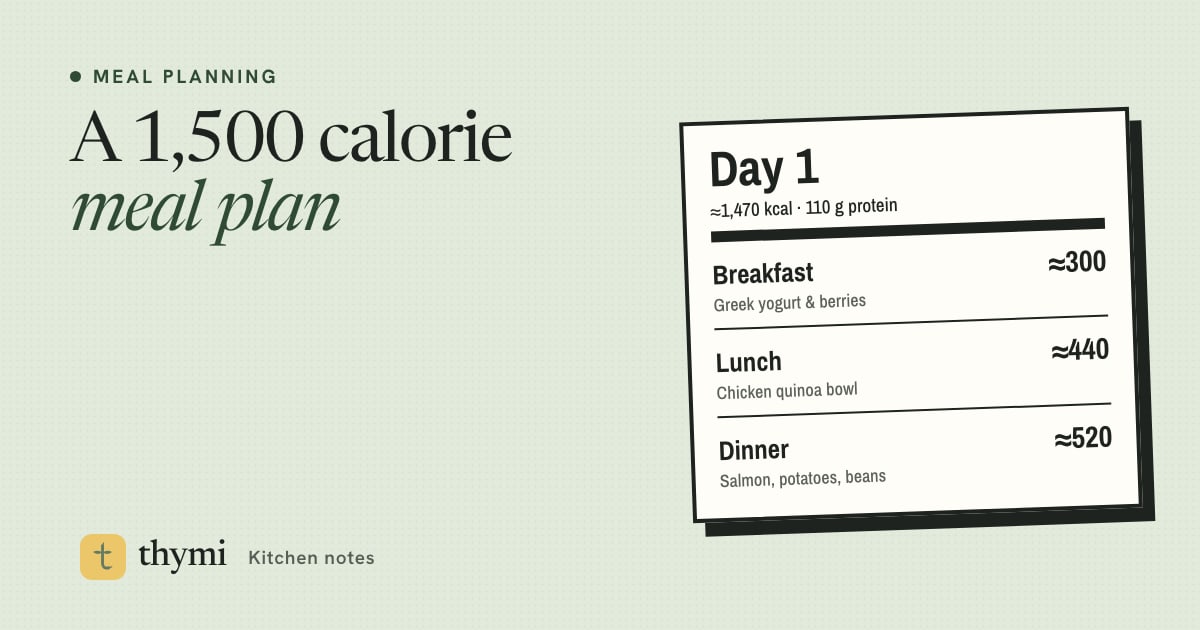
A good 1,500 calorie meal plan splits the day into roughly 350 calories at breakfast, 450 at lunch, 500 at dinner and 200 for a snack, with about 100 g or more of protein so you stay full. Below is a full 7-day 1,500 calorie meal plan built from ordinary supermarket food, with approximate calories and protein for every meal, the portions behind each one and a consolidated grocery list. It suits some smaller or less active adults; many people need more, so check your own number first.
Is 1,500 calories right for you?
1,500 calories a day is a common weight-loss target, but it is not a universal one. Whether it is sensible depends on how much energy your body uses, which varies with your size, age, sex and activity level. For context, the Dietary Guidelines for Americans estimate that most sedentary adult women need about 1,600 to 2,000 calories a day to maintain weight, and sedentary men about 2,000 to 2,400. The NHS weight loss plan starts women at about 1,400 calories a day and men at about 1,900.
That means 1,500 calories tends to suit:
- Smaller adults, often women, who are lightly active or sedentary.
- Older adults whose energy needs have dropped.
- People whose estimated maintenance is around 1,900 to 2,100 calories, for whom 1,500 gives a moderate deficit.
It is usually too low for taller or very active people, most men, and anyone training hard. If your maintenance is 2,600 calories, 1,500 is a deficit of more than 1,000 a day, which is hard to sustain and makes it difficult to get enough protein and nutrients. A deficit of roughly 300 to 500 calories a day is a more comfortable starting point for most people. Work out your own number with our guide to how many calories you should eat a day, and read about choosing a calorie deficit that fits.
Good to know: this plan is an example for healthy adults, not a prescription. If you are pregnant or breastfeeding, have a medical condition, take medication that affects appetite or blood sugar, or have a history of disordered eating, talk to a doctor or registered dietitian before following any calorie target.
How this 1,500 calorie diet meal plan is built
Every day in the plan follows the same rules, so you can swap meals between days and still land close to 1,500 calories:
- Three meals and one snack. Breakfast about 300 to 375 calories, lunch about 440 to 540, dinner about 450 to 540 and a snack of about 130 to 210.
- Protein at every meal. Each day lands between about 105 and 120 g, mostly from chicken, fish, eggs, Greek yogurt, cottage cheese, beans and tofu. See how much protein you need a day for why that helps on fewer calories.
- Vegetables or fruit at most meals, for fiber and volume, plus whole grains, beans or lentils on most days.
- Measured fats. Cooking oil, cheese, nuts and avocado are counted, because they are where a 1,500 calorie day most often goes wrong.
- Built for leftovers. One chicken bowl covers three lunches and one pot of turkey chili covers three meals, so you cook far fewer times than you eat.
Calorie and protein values are rounded estimates based on typical USDA FoodData Central entries for the portions listed. Brands differ, so check labels and adjust; small differences do not matter over a week.
The 7-day 1,500 calorie meal plan
Each cell shows the meal with its approximate calories and grams of protein. The daily totals sit between about 1,470 and 1,535 calories, averaging just under 1,500.
| Day | Breakfast | Lunch | Snack | Dinner | Total |
|---|---|---|---|---|---|
| Day 1 | Greek yogurt, berries & walnuts ≈ 300 kcal · 26 g | Chicken quinoa bowl ≈ 440 kcal · 42 g | Apple & cheddar ≈ 210 kcal · 7 g | Salmon, roast potatoes, green beans ≈ 520 kcal · 35 g | ≈ 1,470 kcal 110 g |
| Day 2 | Eggs, toast & cottage cheese ≈ 365 kcal · 29 g | Chicken quinoa bowl ≈ 440 kcal · 42 g | Carrots & hummus ≈ 155 kcal · 5 g | Turkey chili with rice ≈ 540 kcal · 41 g | ≈ 1,500 kcal 117 g |
| Day 3 | Berry overnight oats ≈ 375 kcal · 24 g | Chicken quinoa bowl ≈ 440 kcal · 42 g | Boiled egg & pear ≈ 175 kcal · 7 g | Sheet-pan shrimp fajitas ≈ 480 kcal · 37 g | ≈ 1,470 kcal 110 g |
| Day 4 | Greek yogurt, berries & walnuts ≈ 300 kcal · 26 g | Turkey chili & an apple ≈ 535 kcal · 39 g | Cottage cheese & pineapple ≈ 130 kcal · 12 g | Chicken pesto pasta & side salad ≈ 530 kcal · 40 g | ≈ 1,495 kcal 117 g |
| Day 5 | Spinach & feta omelet, toast ≈ 330 kcal · 22 g | Turkey chili with rice ≈ 540 kcal · 41 g | Skyr & banana ≈ 190 kcal · 16 g | Crumbed cod, oven fries, peas ≈ 450 kcal · 39 g | ≈ 1,510 kcal 118 g |
| Day 6 | Avocado toast with poached eggs ≈ 365 kcal · 22 g | Tuna sandwich & grapes ≈ 445 kcal · 38 g | Skyr & almonds ≈ 185 kcal · 18 g | Lean beef burger & sweet potato wedges ≈ 500 kcal · 29 g | ≈ 1,495 kcal 107 g |
| Day 7 | Berry overnight oats ≈ 375 kcal · 24 g | Greek chicken & chickpea salad ≈ 505 kcal · 46 g | Pear & string cheese ≈ 180 kcal · 7 g | Tofu stir-fry with brown rice ≈ 475 kcal · 29 g | ≈ 1,535 kcal 106 g |
Drinks are not included, so stick mainly to water, sparkling water, black coffee and tea. A splash of milk in coffee is about 10 to 20 calories a cup; a large latte can be 150 to 250, so count it or swap it for the snack.
Tip: you do not have to follow the days in order. Any breakfast can swap for any other breakfast, and the same goes for lunches, snacks and dinners, because each slot sits in a similar calorie range.
What goes into each meal
These are the portions behind the numbers. Cooked weights are given for meat and grains unless stated.
Breakfasts
- Greek yogurt bowl (≈ 300 kcal, 26 g protein): 1 cup (225 g) plain 2% Greek yogurt, 3/4 cup (110 g) berries, 1 tbsp (7 g) chopped walnuts and 1 tsp honey.
- Eggs, toast and cottage cheese (≈ 365 kcal, 29 g): 2 scrambled eggs, 1 slice whole-grain toast with 1 tsp butter, 1/2 cup (75 g) cherry tomatoes and 1/2 cup (113 g) low-fat cottage cheese.
- Berry overnight oats (≈ 375 kcal, 24 g): 1/2 cup (40 g) rolled oats, 3/4 cup (180 ml) skim milk, 1/2 cup (115 g) nonfat Greek yogurt, 1 tbsp chia seeds and 1/2 cup (75 g) berries, soaked overnight.
- Spinach and feta omelet (≈ 330 kcal, 22 g): 2 eggs, a handful of spinach and peppers, 1 oz (28 g) feta, cooked with a spray of oil, with 1 slice whole-grain toast.
- Avocado toast with poached eggs (≈ 365 kcal, 22 g): 2 slices whole-grain toast, 1/4 avocado mashed with lemon and chili flakes, and 2 poached eggs.
Lunches
- Chicken quinoa bowl (≈ 440 kcal, 42 g): 4 oz (113 g) roast chicken breast, 1/2 cup (90 g) cooked quinoa, 1 cup roasted peppers, zucchini and red onion, and 1 tbsp tahini-lemon dressing.
- Turkey chili (≈ 440 kcal, 39 g per 1.5-cup portion with 2 tbsp Greek yogurt): made with lean ground turkey, kidney beans, canned tomatoes, onion, peppers and spices. Add 1/2 cup (95 g) cooked brown rice for ≈ 100 kcal more, or an apple.
- Tuna sandwich (≈ 345 kcal, 37 g) plus 1 cup grapes (≈ 100 kcal): one 5 oz (142 g) can of tuna in water, drained, mixed with 1 tbsp light mayo and 2 tbsp Greek yogurt, on 2 slices whole-grain bread with lettuce and tomato.
- Greek chicken and chickpea salad (≈ 505 kcal, 46 g): 4 oz (113 g) chicken, 1/2 cup (80 g) chickpeas, cucumber, tomato and red onion, 1 oz (28 g) feta and 2 tsp olive oil with lemon and oregano.
Dinners
- Salmon, potatoes and green beans (≈ 520 kcal, 35 g): 5 oz (140 g) raw salmon fillet, 5 oz (140 g) potatoes roasted in 1 tsp olive oil, 1 cup green beans with 1 tsp oil or butter, and a squeeze of lemon.
- Turkey chili with rice (≈ 540 kcal, 41 g): 1.5 cups chili, 2 tbsp Greek yogurt and 1/2 cup (95 g) cooked brown rice.
- Sheet-pan shrimp fajitas (≈ 480 kcal, 37 g): 5 oz (140 g) shrimp and sliced peppers and onion roasted with 2 tsp oil and fajita spices, in 2 small corn tortillas with salsa, 2 tbsp Greek yogurt and 1/4 avocado.
- Chicken pesto pasta (≈ 530 kcal, 40 g with side salad): 2 oz (56 g) dry whole-wheat pasta, 3 oz (85 g) chicken, zucchini and spinach, 1 tbsp pesto and 1 tbsp grated parmesan, plus a side salad with 1 tsp olive oil.
- Crumbed cod, oven fries and peas (≈ 450 kcal, 39 g): 6 oz (170 g) cod topped with 2 tbsp panko and baked, 5 oz (140 g) potato wedges with 1 tsp oil, and 1/2 cup (80 g) peas.
- Lean beef burger (≈ 500 kcal, 29 g): a 4 oz (113 g) raw 93% lean beef patty in a whole-wheat bun with lettuce, tomato and mustard, 4 oz (113 g) sweet potato wedges with 1 tsp oil, and a side salad.
- Tofu stir-fry (≈ 475 kcal, 29 g): 5 oz (140 g) firm tofu, 2 cups stir-fry vegetables, 2 tsp oil, soy sauce, garlic and ginger, over 1/2 cup (95 g) cooked brown rice.
Snacks
An apple with 1 oz (28 g) cheddar, carrots with 3 tbsp hummus, a boiled egg and a pear, 1/2 cup cottage cheese with pineapple, a skyr or Icelandic-style yogurt pot (5.3 oz, 150 g) with a small banana or 1/2 oz (14 g) almonds, or a pear with a string cheese. For more options in the same range, see our list of snacks under 200 calories.
1,500 calorie meal plan grocery list
This consolidated grocery list covers all seven days for one person. Quantities are rounded up to typical pack sizes, and you will have some staples left over for next week.
| Section | What to buy |
|---|---|
| Meat, fish & tofu | Chicken breast about 1.75 lb (800 g) raw; lean ground turkey 1 lb (450 g); salmon fillet 5 oz (140 g); cod fillet 6 oz (170 g); raw peeled shrimp 5 oz (140 g), frozen is fine; 93% lean ground beef 4 oz (113 g); 1 block firm tofu, 14 oz (400 g); 1 can tuna in water, 5 oz (142 g) |
| Eggs & dairy | 1 dozen eggs; plain Greek yogurt, 32 oz (about 900 g) tub; low-fat cottage cheese, 16 oz (450 g); 2 skyr pots; skim milk, 1 quart (1 L); small block cheddar; feta, 4 oz (113 g); 1 string cheese; parmesan; butter |
| Fruit | Mixed berries, 1 lb (450 g) frozen bag; 2 apples; 2 pears; 1 small banana; small bunch of grapes; pineapple, fresh or canned in juice; 1 avocado; 2 lemons |
| Vegetables | 5 bell peppers; 2 zucchini; 3 onions (1 red); 1 lb (450 g) potatoes; 1 sweet potato; bag of spinach; salad leaves; cherry tomatoes; 2 tomatoes; 1 cucumber; baby carrots; garlic; fresh ginger; frozen green beans; frozen peas; 1 lb (450 g) frozen stir-fry vegetables |
| Grains & bread | Whole-grain bread loaf; rolled oats; quinoa; brown rice (or microwave pouches); whole-wheat pasta; small corn tortillas; 1 whole-wheat burger bun; panko breadcrumbs |
| Cans & jars | 2 cans chopped tomatoes, 14.5 oz (400 g); 1 can kidney beans; 1 can chickpeas; hummus, 8 oz (227 g) tub; salsa; small jar pesto; light mayo; tahini; soy sauce; mustard |
| Pantry | Olive oil and oil spray; honey; walnuts; almonds; chia seeds; chili powder, cumin, smoked paprika, oregano and fajita seasoning |
For a broader list of staples worth keeping in stock, see our healthy grocery list. If you are shopping on a tight budget, swap salmon and shrimp for canned salmon, eggs or more beans; our cheap healthy meal plan has more ideas.
How to prep the week in two short sessions
Most cooked leftovers keep about 3 to 4 days in the fridge at 40°F (4°C) or below, in line with USDA guidance, so this plan works best with two short sessions rather than one marathon.
- Day 1 (about 60 minutes): roast the chicken breast and a big tray of peppers, zucchini and red onion; cook the quinoa; whisk the tahini dressing; portion three chicken bowls. Cook the turkey chili and divide it into three portions, freezing one if Day 5 is more than four days away. Make overnight oats for Day 3.
- Day 4 (about 30 minutes): cook a pot of brown rice for Days 5 and 7, set aside cooked chicken for the Day 7 salad (or roast a fresh batch), make overnight oats for Day 7 and chop salad vegetables.
- Every evening: the dinners not covered above (salmon, fajitas, pasta, cod, burger, stir-fry) each take 20 to 30 minutes from scratch.
For the batch-cooking side in more depth, read our guide to meal prep for weight loss. If you want to build your own week from scratch instead of following this one, our guide to how to meal plan for weight loss walks through the system step by step.
Swaps: vegetarian, dairy-free and budget
The plan is easy to adapt. Keep the calories and protein roughly the same by swapping like for like:
| Instead of | Try | Notes |
|---|---|---|
| Chicken in the bowls and salad | Extra-firm tofu, tempeh or 1 cup cooked lentils | Lentils add fiber; protein is a little lower, so add a yogurt or egg elsewhere |
| Turkey chili | Three-bean and lentil chili | Use 1.5 cups and top with Greek yogurt or cheese for protein |
| Salmon, cod or shrimp | Canned salmon, eggs or tofu | Cheaper and still high in protein |
| Greek yogurt, skyr, cottage cheese | Soy yogurt or a high-protein plant yogurt | Check labels; many plant yogurts are lower in protein |
| Cheddar or feta snacks | Roasted chickpeas or edamame | About 1/2 cup is in a similar calorie range |
If you prefer a Mediterranean style of eating, our Mediterranean diet meal plan uses more beans, fish and olive oil, and our high protein meal plan pushes protein higher still.
Making 1,500 calories feel like enough
The biggest risk with any lower-calorie plan is hunger. A few habits make a real difference:
- Eat protein at every meal. It is the most filling macronutrient, and spreading it out keeps you satisfied through the day.
- Fill up on vegetables. Half a plate of vegetables adds volume for very few calories. Our guide to foods that keep you full explains why.
- Measure the fats. One tablespoon of oil is about 120 calories, and an extra one per day is almost 10% of the whole plan.
- Do not save everything for dinner. Skipping breakfast and lunch to "bank" calories usually ends in snacking later.
- Watch the trend, not the scale each morning. Weight goes up and down with water and food volume. Look at your average over two to four weeks.
- Adjust if it is too hard. If you are constantly hungry, tired or losing more than about 2 lb (1 kg) a week after the first couple of weeks, raise your intake. A 1,600 or 1,800 calorie plan you can keep is better than a 1,500 one you abandon. Our 2,000 calorie meal plan shows how the same meals scale up.
Log what you actually eat, including the days that do not go to plan. Over a few weeks, that honest record tells you far more than any single day.
Frequently asked questions
Is 1,500 calories a day enough?
For some smaller or less active adults, 1,500 calories a day is a reasonable weight-loss target. For many others, especially taller, younger or very active people and most men, it is too low and makes it hard to get enough protein and nutrients. Estimate your maintenance calories first and aim for a deficit of roughly 300 to 500 calories, and check with a doctor or dietitian if you are unsure.
How much weight will I lose on 1,500 calories a day?
It depends on how many calories you burn. If your maintenance is around 2,000 calories, a 1,500 calorie day is a deficit of about 500, which often leads to a loss of roughly 0.5 to 1 lb (0.25 to 0.5 kg) a week over time. Day-to-day weight changes are mostly water, so judge progress by your average over several weeks.
How much protein should a 1,500 calorie meal plan have?
Many people do well with about 90 to 120 g of protein a day on 1,500 calories, which is roughly 25 to 30% of calories. This plan averages about 112 g a day, spread across three meals and a snack, which helps with fullness and with keeping muscle while you lose weight.
Can I follow a 1,500 calorie meal plan as a vegetarian?
Yes. Swap chicken, fish and meat for tofu, tempeh, eggs, lentils and beans, and lean on Greek yogurt, skyr and cottage cheese for protein. Lentils and beans are lower in protein per calorie than chicken, so add an extra yogurt or egg on some days to stay near 100 g of protein.
Can I eat out on a 1,500 calorie meal plan?
Yes. Choose a dish with a clear protein and vegetables, ask for sauces and dressings on the side, and estimate the meal as best you can. Then move the planned meal to another day and carry on. One restaurant meal will not undo a week; your weekly average is what matters.
This article is general information for healthy adults, not medical or nutritional advice. Talk to a doctor or registered dietitian before changing how you eat, especially if you are pregnant or breastfeeding, have or have had an eating disorder, have a medical condition, or take medication.