Meal planning
How to Meal Plan for Weight Loss (a Simple Weekly System)
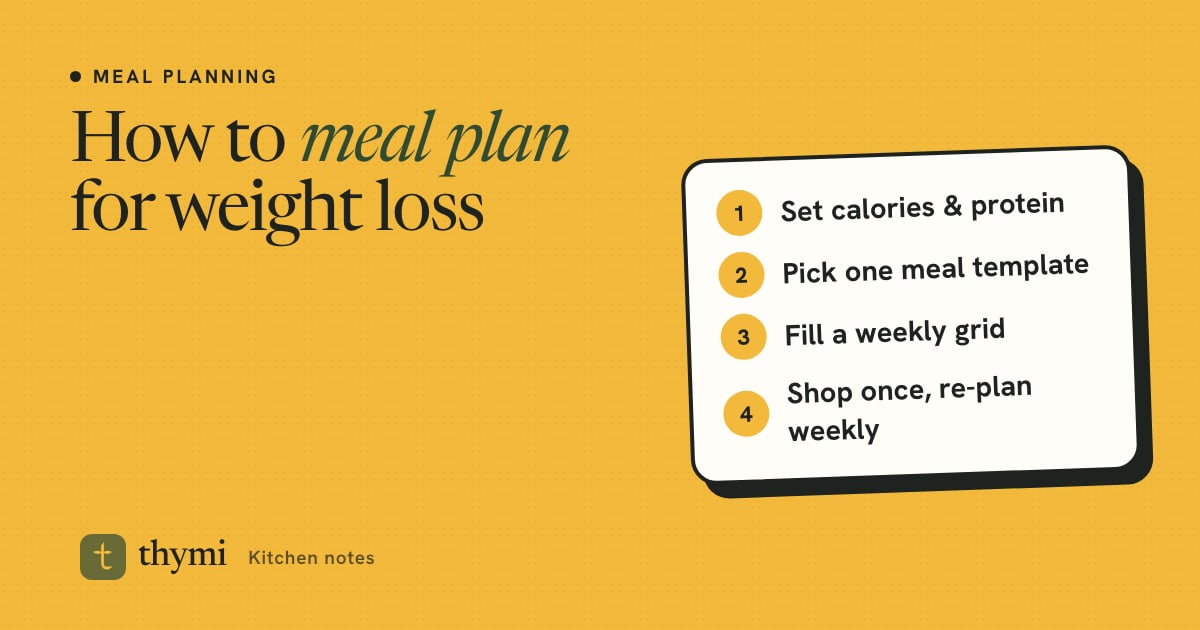
To meal plan for weight loss, set a daily calorie and protein target, split it across the meals you actually eat, and fill a simple weekly grid with a few repeatable meals built from a protein, vegetables, a measured carb and a little fat. Turn that grid into one grocery list, cook some of it in batches, and leave a gap or two for leftovers and eating out. Review on the weekend and adjust; the plan works because it is easy to repeat, not because it is perfect.
Why meal planning helps with weight loss
Weight loss comes down to eating a little less energy than you use, consistently, for weeks at a time. Meal planning does not change that equation. What it changes is how many food decisions you have to make when you are tired, hungry or short on time, which is exactly when most plans fall apart.
A good meal plan does a few useful things at once:
- It sets portions in advance. You decide how much pasta or oil goes into dinner on a calm Sunday, not at 7:30 pm on a Wednesday.
- It protects your protein. Planned meals are far more likely to include a real portion of protein, which helps with fullness and with keeping muscle while you eat less.
- It cuts waste and cost. One planned shop replaces several top-up trips, and you buy what you will actually cook.
- It makes tracking quicker. If you know Tuesday's lunch is the same chicken bowl as Monday's, logging it takes seconds.
Meal planning and meal prep are related but different. Planning is deciding what you will eat; prep is cooking some of it ahead. You can plan without prepping much at all. If you want the batch-cooking side in detail, see our guide to meal prep for weight loss.
Step 1: Set your calorie and protein target
A meal plan needs a number to aim at. Start with an estimate of your daily calorie needs (your TDEE) and take a modest amount off it. A deficit of roughly 300 to 500 calories a day is a common, sustainable starting point for many adults, and tends to give a loss of somewhere around 0.5 to 1 lb (0.25 to 0.5 kg) a week, though real-world results vary. If you have not worked out your numbers yet, start with how many calories you should eat a day and our guide to choosing a calorie deficit that you can actually live with.
For context, the Dietary Guidelines for Americans estimate that many moderately active adult women need roughly 1,800 to 2,200 calories a day to maintain weight, and men roughly 2,200 to 2,800, depending on age, with less for sedentary adults. The NHS weight loss plan uses about 1,400 calories a day for women and 1,900 for men as a starting point. These are broad ranges, not personal prescriptions.
Then set a protein goal. The baseline recommendation for adults is 0.8 g of protein per kg of body weight (about 0.36 g per lb), but many people find that something closer to 1.2 to 1.6 g per kg (0.5 to 0.7 g per lb) makes a calorie deficit easier, because protein is filling. For a lot of people that works out to roughly 90 to 130 g a day. Our guide to how much protein you need a day walks through the maths.
Good to know: do not chase a very low target to speed things up. Eating far too little makes plans harder to stick to and can leave you short on nutrients. If you are unsure what is right for you, a doctor or registered dietitian can help you set a safe target.
Step 2: Split your day into meals
Next, divide your daily target across the meals you really eat. There is no metabolic magic in three meals versus four, or eating breakfast versus skipping it. Pick the rhythm that fits your days, then give each meal a rough calorie budget so you know what "a lunch" looks like.
| Daily target | Breakfast | Lunch | Dinner | Snacks |
|---|---|---|---|---|
| About 1,500 kcal | ≈ 350 | ≈ 450 | ≈ 500 | ≈ 200 |
| About 1,800 kcal | ≈ 400 | ≈ 500 | ≈ 600 | ≈ 300 |
| About 2,100 kcal | ≈ 450 | ≈ 600 | ≈ 700 | ≈ 350 |
Treat these as starting points. If you are hungriest in the evening, move calories from breakfast to dinner. If you train in the morning, do the opposite. Aim for about 25 to 40 g of protein at each main meal, which makes a daily goal of around 100 g much easier than trying to catch up at dinner.
If you want to see what a full week looks like at the lower end, our 1,500 calorie meal plan shows seven days of real meals with calories and protein for each.
Step 3: Use one meal template for everything
The most useful trick for meal planning beginners is to stop thinking in recipes and start thinking in slots. Almost every filling, weight-loss-friendly meal fits the same four-part template:
| Slot | Examples | Typical portion | Approx. kcal |
|---|---|---|---|
| Protein | Chicken, fish, eggs, Greek yogurt, tofu, lean beef, beans, lentils | e.g. 4 oz (113 g) cooked chicken breast | ≈ 185 |
| Vegetables | Salad leaves, broccoli, peppers, green beans, tomatoes, frozen mixed veg | Half the plate, 1 to 2 cups (150 to 250 g) | ≈ 30–80 |
| Carb | Rice, potatoes, pasta, bread, oats, quinoa, tortillas, fruit | e.g. 3/4 cup (140 g) cooked rice | ≈ 150–200 |
| Fat or sauce | Olive oil, cheese, avocado, nuts, pesto, dressing | e.g. 1 tbsp (14 g) olive oil | ≈ 120 |
| Total | One balanced plate | ≈ 485–585 | |
Values are approximate, based on typical USDA FoodData Central entries. The template is flexible on purpose. To bring a meal down, trim the carb or the fat slot, never the protein or vegetables. To bring it up, add a little more carb or a piece of fruit. Breakfasts follow the same idea in miniature: Greek yogurt with fruit and a few nuts, or eggs with toast and tomatoes, both tick protein, carb and fat. Our list of high protein breakfasts has plenty more.
Tip: fat is the slot that drifts most. A "drizzle" of oil can easily be 2 or 3 tablespoons, which is 240 to 360 calories. Measure oil, nut butter and dressings for the first couple of weeks until your eye is calibrated.
Step 4: Fill a weekly meal plan grid
Now make the actual plan. Draw a simple grid with the days across the top and your meals down the side, or use a planner app. Then fill it in this order, which keeps decisions to a minimum:
- Block out the known gaps first. A work dinner on Thursday, takeout on Friday, a family lunch on Sunday. Do not plan meals you will not eat.
- Pick one or two breakfasts and repeat them. Most people happily eat the same breakfast all week.
- Choose three to five dinners, each using the template above. Pick at least one that makes enough for leftovers.
- Fill lunches with leftovers or one batch-cooked lunch, so you cook once and eat twice.
- Add snacks last, only if your calorie budget and hunger call for them. Our list of snacks under 200 calories is a handy menu.
Here is what a simple beginner week might look like for someone aiming at about 1,800 calories:
| Day | Breakfast | Lunch | Dinner |
|---|---|---|---|
| Mon | Greek yogurt, berries, walnuts | Chicken, rice and roasted veg bowl | Turkey chili with rice (makes 4 portions) |
| Tue | Greek yogurt, berries, walnuts | Leftover turkey chili | Salmon, potatoes, green beans |
| Wed | Eggs on whole-grain toast | Chicken, rice and roasted veg bowl | Shrimp stir-fry with noodles |
| Thu | Eggs on whole-grain toast | Leftover turkey chili | Work dinner (unplanned) |
| Fri | Overnight oats with milk and yogurt | Tuna and bean salad | Homemade chicken fajitas |
| Sat | Overnight oats with milk and yogurt | Leftover fajita bowl | Eating out |
| Sun | Veggie omelet and toast | Freezer chili or family lunch | Roast chicken, vegetables, potatoes |
Notice how little cooking that actually involves: three breakfasts, one batch lunch, one big pot of chili and four simple dinners. Repetition is a feature, not a flaw. As long as the week still includes a range of vegetables, fruit, whole grains and protein sources, eating the same lunch three times is perfectly fine.
Step 5: Turn the plan into a grocery list
Once the grid is done, go through it meal by meal and write down every ingredient with a rough quantity. Then merge duplicates: if three meals use chicken breast, that is one line on the list with the total amount. Check your fridge, freezer and cupboards and cross off anything you already have.
Grouping the list by store section (produce, meat and fish, dairy, grains and bread, cans and jars, frozen) makes the shop faster and keeps you away from aisles you did not plan for. A few staples are worth keeping in stock all the time because they rescue a week that goes sideways:
- Frozen vegetables and berries, which are as nutritious as fresh and never go off before you use them.
- Canned beans, lentils, tuna and tomatoes for a quick protein-rich meal.
- Eggs and Greek yogurt for fast breakfasts and snacks.
- Quick carbs such as microwave rice pouches, whole-grain wraps and oats.
For a ready-made starting point, see our healthy grocery list, and if budget matters, our guide to a cheap healthy meal plan.
Step 6: Prep a little and log as you go
You do not need a four-hour Sunday cook-up. A short session that handles the slow parts of the week is enough for most people:
- Cook one pot of grains (rice or quinoa) and one tray of roasted vegetables.
- Cook or marinate the protein for your batch lunch.
- Wash and chop salad vegetables, and portion breakfasts like overnight oats.
- Make any big-batch dinner, like chili or a curry, and freeze a portion or two.
Most cooked leftovers keep about 3 to 4 days in the fridge at 40°F (4°C) or below, in line with USDA guidance, so plan a second short cook mid-week or freeze what you will not eat by then.
Logging is what turns a meal plan into a weight-loss tool. If your planned lunch is the same chicken bowl four times, weigh it once, save it as a meal and add it with one tap after that. On days you eat something different, log that instead. A plan you deviate from but track honestly is far more useful than a perfect plan you do not follow. Our food diary guide covers simple ways to keep the habit going.
Step 7: Review and re-plan each week
Spend ten minutes at the end of the week looking back before you plan forward. Ask three questions:
- What did I actually eat? Which planned meals got skipped, and why? If Wednesday's dinner never happens, it is too ambitious for a Wednesday.
- Was I hungry? If you were ravenous every afternoon, add a protein-rich snack or move calories to lunch. Our guide to foods that keep you full can help.
- Is the trend moving? Look at your average weight over two to four weeks, not day-to-day changes. If nothing has moved after about a month of consistent eating, trim your target by around 100 to 200 calories a day.
Keep the meals that worked, swap out the ones that did not, and reuse most of last week's grid. After three or four weeks you will have a rotation of ten or so meals you like and can plan a week in a few minutes.
Life will get in the way, and that is fine. When you eat out unexpectedly, push the planned meal to another day or freeze it, log the restaurant meal as best you can (our guide to tracking calories when eating out helps), and pick up with the next planned meal. One off-plan meal does not undo a week.
Meal planning mistakes beginners make
- Planning 21 brand-new recipes. Start with what you already cook and add one new meal a week.
- Leaving no slack. Plan five or six dinners, not seven. Leftovers, takeout and late nights will fill the rest.
- Cutting too hard. Very small portions lead to snacking and rebounds. A modest deficit you can repeat beats an aggressive one you cannot.
- Forgetting protein at breakfast and lunch. It is hard to reach 100 g or more if two meals are mostly toast and pasta.
- Ignoring drinks and extras. Lattes, juice, alcohol and cooking oil all count, and they rarely make it onto the plan.
- Treating the plan as pass or fail. The goal is a good average over weeks, not a perfect Monday.
Keep the system small, repeatable and honest, and it will do most of the work for you.
Frequently asked questions
How do I start meal planning for weight loss?
Start with a rough daily calorie target and a protein goal, then plan just your dinners and lunches for one week using a simple template: a protein, a vegetable, a measured carb and a little fat. Write a grocery list from that plan, cook a couple of meals in batches, and review what worked at the end of the week.
How many meals should I plan per week?
Beginners do well planning five dinners and three or four lunches, then repeating one or two breakfasts. Leave one or two meals unplanned for leftovers, eating out or a freezer meal. You can plan more once the habit feels easy.
How many calories should each meal be for weight loss?
Divide your daily target across the meals you actually eat. On about 1,800 calories, for example, a common split is roughly 400 for breakfast, 500 for lunch, 600 for dinner and 300 for snacks. The exact split matters less than hitting your daily total and getting protein at each meal.
Is it OK to eat the same meals every day?
Yes, repeating meals is one of the easiest ways to stay on track, as long as your week still includes a range of vegetables, fruit, whole grains and protein sources. Rotating two or three breakfasts and lunches and varying your dinners keeps things balanced without extra planning.
What if I eat out or go off plan?
Treat the plan as a guide, not a test. Log the meal as best you can, move the planned meal to another day or freeze it, and carry on with your next planned meal. One meal does not undo a week; what counts is your average over several weeks.
This article is general information for healthy adults, not medical or nutritional advice. Talk to a doctor or registered dietitian before changing how you eat, especially if you are pregnant or breastfeeding, have or have had an eating disorder, have a medical condition, or take medication.