Habits
Weekend Calories: How to Stay on Track Without Giving Up Your Weekend
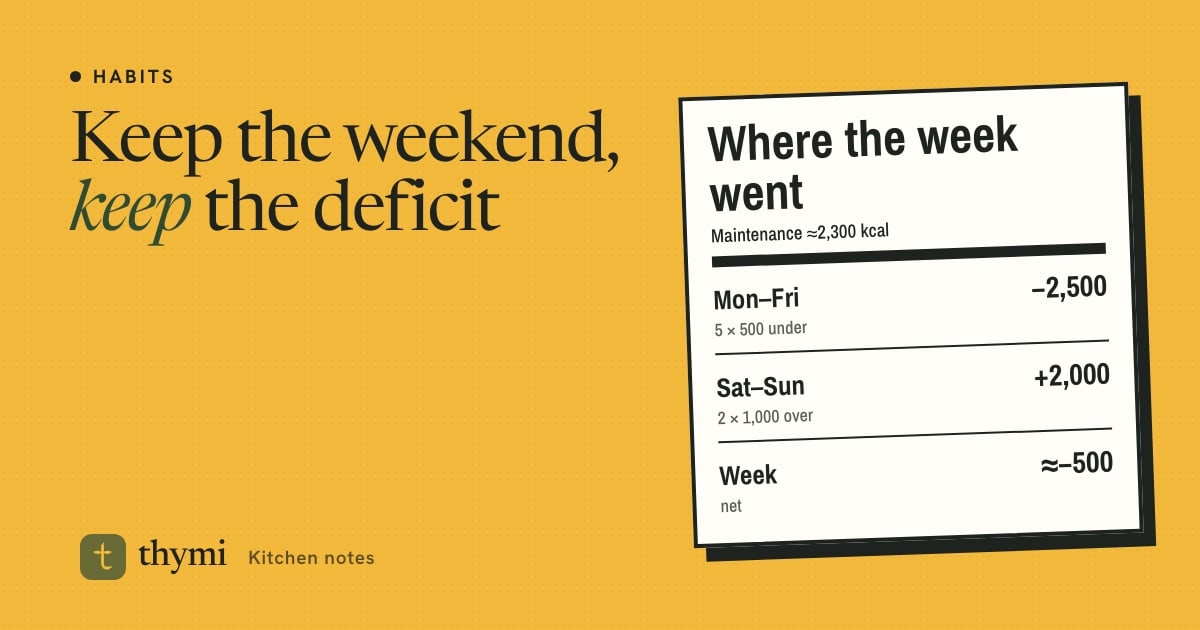
To stay on track on weekends, plan for them instead of fighting them: think in weekly averages, keep a little room in your weekday calories, start each weekend meal with protein, pick one treat on purpose, decide on drinks in advance and log quickly even when it is messy. Weekends rarely ruin progress because of one meal. They do it through two or three days of small extras that add up to more than the weekday deficit.
Why weekends can undo a weekday deficit
Here is a common pattern with realistic numbers. Say your maintenance calories, your TDEE, are about 2,300 kcal a day, and you aim for 1,800 on weekdays. That is a 500 kcal deficit, five days in a row:
- Monday to Friday: 5 × 500 = about 2,500 kcal below maintenance.
Then the weekend arrives. Nothing dramatic happens. A long brunch, some snacks in the afternoon, dinner out, a few drinks, something on the way home. A Saturday like that can easily come to 3,000–3,300 kcal:
| A fairly ordinary Saturday | Approx. calories |
|---|---|
| Brunch: eggs, toast, bacon or avocado, a latte | 700–900 |
| Afternoon grazing: chips, cookies, a bit of everything | 300–500 |
| Dinner out: main, shared starter, bread | 1,000–1,200 |
| Three regular beers or glasses of wine | 360–450 |
| Late-night snack | 250–350 |
| Total | ≈ 2,600–3,400 |
Call it about 3,300 kcal, toward the top of that range once a sweet coffee or a dessert slips in, and repeat it on Sunday. That is about 1,000 kcal above maintenance each day:
- Saturday and Sunday: 2 × 1,000 = about 2,000 kcal above maintenance.
- The week overall: 2,500 − 2,000 = a deficit of about 500 kcal, not the 3,500 you planned for.
Five careful days, and the week ends up close to maintenance. That is not a willpower problem. It is arithmetic, and it explains why so many people feel they are "doing everything right" and seeing little change. If this sounds familiar, our guide to the weight loss plateau covers other reasons progress can stall.
Good to know: these are illustrative numbers, not a measurement of anyone's weekend. Restaurant meals vary a lot, and the point is the pattern: a small surplus over two days can match a modest deficit over five.
The usual weekend culprits
Weekend extras tend to come from the same few places. Spotting yours is most of the work.
- Drinks. A regular beer is about 150 kcal and a 5 oz (150 ml) glass of wine about 120–125 kcal. Alcohol also tends to loosen food decisions later in the evening. Our guide to calories in alcohol has a full comparison.
- Eating out. Restaurant meals are often larger and richer than home cooking, with more oil, butter and sauce than you would guess.
- Grazing. At home, with no fixed routine, it is easy to snack every hour. Individually small, together a meal.
- Later nights. More hours awake means more chances to eat, and short sleep can make you hungrier the next day.
- Brunch. Brunch often replaces breakfast and lunch in name only, then gets followed by a full dinner anyway. Pastries, juices and sweet coffees add up quietly.
- The "fresh start Monday" mindset. If Monday is when things restart, Friday night becomes the last chance, and the weekend gets bigger than it needed to be.
Average your week, not your days
Your body responds to your intake over weeks, not to any single day. That gives you a lot of freedom. Instead of trying to hit the same number seven days in a row, think of a weekly total.
Using the example above, a 1,800 kcal daily target is about 12,600 kcal for the week. If you eat about 1,700 on weekdays, Saturday and Sunday can each be about 2,050 and the week still averages 1,800. Those weekend days are not "over"; they are part of the plan. Seen this way, a weekend is something you plan for, not something that happens to you.
Two cautions. First, a weekly average is not permission for one enormous day; a 4,000 kcal Saturday is hard to balance and usually leaves you feeling rough. Second, keep it simple. You do not need a spreadsheet, just a rough sense of where your week is heading. If you are not sure what your target should be, start with how many calories you should eat a day and how big a calorie deficit should be.
Bank a little, without starving
One gentle way to make room for the weekend is to eat a little under your target on weekdays. The key word is little.
- Eat about 100–150 kcal less on weekdays. Five days of 100 kcal less gives you about 500 kcal of extra room, which spreads into an extra 250 kcal or so on Saturday and Sunday. That is a dessert or a couple of drinks, planned.
- Do not bank by skipping meals. Very low weekdays tend to backfire: you arrive at Friday tired and very hungry, and the weekend gets bigger, not smaller.
- Keep a floor. Do not let any day drop under about 1,200 kcal, and for many people the safe floor is higher. Banking should feel like a small trim, not a fast.
- Do not "pre-pay" on Saturday morning. Skipping breakfast to save room for dinner often leads to grazing all afternoon. A normal, protein-rich breakfast usually works better.
Protein-first weekend meals
Protein is the most filling of the macronutrients for most people, so starting a meal with it makes the rest of the meal easier to keep sensible. On weekends that looks like:
- Brunch: eggs, Greek yogurt, smoked salmon or beans as the base, with toast or pancakes alongside rather than as the whole plate. Our high protein breakfast ideas work just as well at 11 am.
- Eating out: choose the main for the protein (grilled chicken, fish, steak, tofu, lentils), then decide on the extras.
- At home: a planned lunch with real protein ends a lot of aimless afternoon snacking.
- Add vegetables and fiber. A side salad or vegetables with each meal adds volume for few calories. See foods that keep you full for more ideas.
Not sure what your target is? Our guide on how much protein you need a day explains the common ranges.
The one-treat rule
The one-treat rule is simple: each weekend day, pick one thing you really want and enjoy it fully. Dessert at dinner, pastries at brunch, a cocktail, the good chips at the movies. One.
It works because it replaces lots of small, half-noticed extras with one deliberate choice. A slice of cake you sat down and enjoyed is a better use of 400 kcal than a handful of this and that while standing in the kitchen. It also removes the all-or-nothing feeling: nothing is off-limits, so there is no reason to "use up" the weekend before Monday.
Tip: choose your treat early in the day. "Tonight it's dessert" makes the afternoon cookies easy to skip, because you already know what you are looking forward to.
A drinks plan that still feels like a weekend
Drinks are the single easiest place to lose track, because they rarely feel like food. If you choose to drink, a plan made in advance helps:
- Decide the number before you go out, and log the first drink when you order it.
- Alternate with water or a zero-sugar soft drink. It slows the pace and helps the next morning too.
- Choose lighter options when you want more than one. A spirit with a diet mixer is about 95–100 kcal, similar to a light beer, while sweet or creamy cocktails can be 200 kcal or more each.
- Eat a proper meal first. Drinking on an empty stomach makes the late-night snack far more likely.
- Remember that not drinking is always a fine choice. Health guidelines generally say less alcohol is better for health, and a sparkling water with lime still counts as joining in.
Log it, even when it is messy
Weekend logs are rarely precise, and that is fine. A rough log is far more useful than a blank one, because a blank weekend hides exactly the pattern you want to see. The goal is "close enough", not perfect.
- Snap a photo of the plate before you eat. It takes two seconds, even at a restaurant. Our guide to logging food with a photo shows how to get a good estimate.
- Describe it later if you forgot the photo: "a burger, half the fries and two beers" is enough to get a reasonable number.
- Round up for restaurants. Assume a bit more oil and a bigger portion than you would serve at home. Our guide to tracking calories when eating out has more tactics.
- Log the drinks and the bites. The shared starter and the second glass of wine are what usually go missing.
In Thymi you can log by photo or a quick description, then use Fix it to adjust in plain words, like "I only had half the fries". If you use the Menu board, tap "Eating out?" and it re-plans the rest of your day around the meal, so a big brunch simply means a lighter, protein-rich dinner instead of a ruined day.
The Monday reset, without punishment
How you handle Monday decides whether the weekend was a blip or the start of a slide. The best Monday is a boring one.
- Go back to your normal target. Not a smaller one. Cutting Monday to 1,000 kcal or adding an extra-long workout "to make up for it" sets up a cycle of restriction and rebound.
- Expect the scale to be up. Salty restaurant food, more carbs and alcohol all make you hold extra water. A jump of up to a kilo or two (2–4 lb) after a weekend is common and mostly not fat. It usually settles within a few days. Our guide on why weight fluctuates day to day explains why.
- Look at the week, not the weekend. If your weekly average landed near your target, the plan is working. If not, pick one culprit from the list above and change just that one next weekend.
- Keep your streak, not your guilt. Logging a big weekend honestly is a success. It is the information you need to plan the next one.
Over months, this matters more than any single weekend. Most people who keep weight off long-term are not perfect on Saturdays. They are consistent across ordinary weeks, which is the core idea in our guide on how to maintain weight loss.
Frequently asked questions
Why do I gain weight over the weekend?
Mostly from two or three days of small extras: drinks, meals out, grazing and later nights. A surplus of about 1,000 kcal on both Saturday and Sunday can cancel most of a 500 kcal daily deficit from Monday to Friday. Part of a Monday jump on the scale is also water from salty food, carbs and alcohol.
Can I have a cheat day and still lose weight?
Yes, if your weekly average stays in a deficit. Rather than an all-out cheat day, most people find one planned treat a day and a protein-first approach easier to balance, because a very large day can cancel several days of deficit.
Should I eat less on weekdays to save calories for the weekend?
A little can help. Eating about 100 to 150 kcal less on weekdays gives you a few hundred calories of room at the weekend. Avoid skipping meals or going under about 1,200 kcal, because very low weekdays often lead to bigger weekends.
How do I track calories when eating out on weekends?
Take a photo of the plate or describe the meal, round up for oil and portion size, and log drinks and shared dishes too. A rough estimate is much more useful than leaving the meal out.
What should I do on Monday after a big weekend?
Go back to your normal calorie target and routine. Do not cut calories sharply or add punishing workouts. Expect some water weight on the scale, which usually settles within a few days, and look at your weekly average rather than the weekend alone.
This article is general information for healthy adults, not medical or nutritional advice. Talk to a doctor or registered dietitian before changing how you eat, especially if you are pregnant or breastfeeding, have or have had an eating disorder, have a medical condition, or take medication.