Food guides
Calories in Chicken Breast: Raw vs Cooked, Grilled, Fried and More
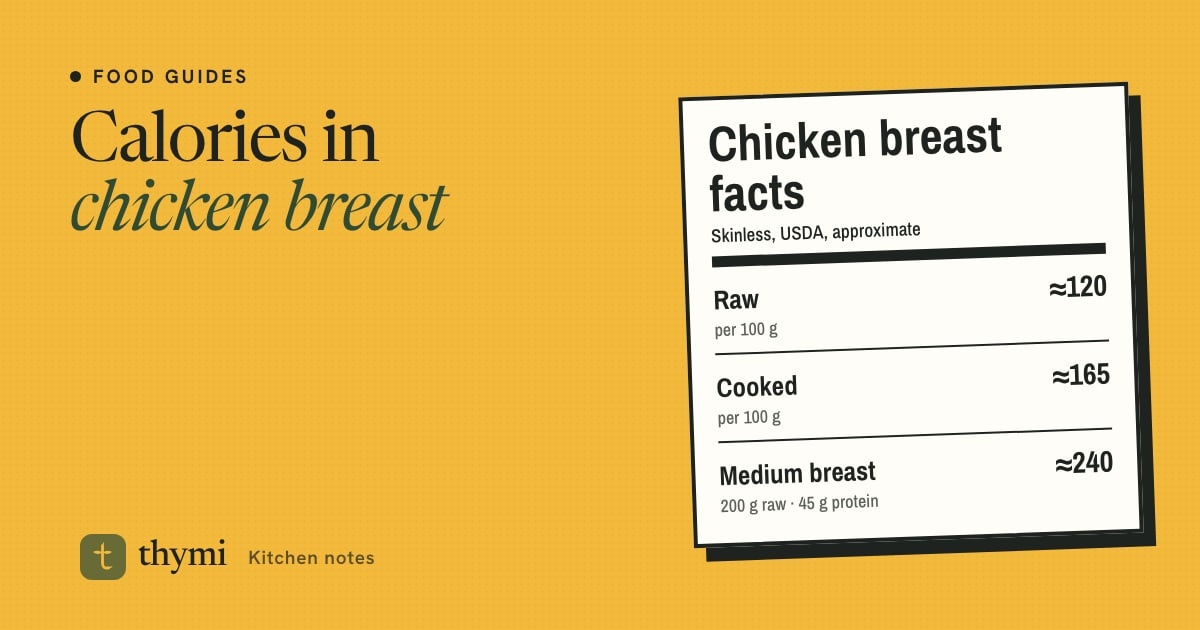
Cooked skinless chicken breast has about 165 calories and 31 g of protein per 100 g (3.5 oz); raw, it has about 120 calories and 22.5 g of protein. A typical boneless breast of about 200 g raw (≈ 145 g cooked) comes to roughly 240 calories and 45 g of protein. The gap between raw and cooked is water, not calories, so the most important thing when logging chicken is to match a raw weight with a raw entry and a cooked weight with a cooked one.
Chicken breast calories: the quick chart
The figures below are approximate USDA FoodData Central values for chicken breast. "Cooked" means roasted or baked with nothing added. Birds and cooking times vary a little, so treat these as good working numbers.
| Chicken breast (per 100 g / 3.5 oz) | Calories | Protein | Fat |
|---|---|---|---|
| Skinless, raw | ≈ 120 | ≈ 22.5 g | ≈ 2.6 g |
| Skinless, cooked (roasted) | ≈ 165 | ≈ 31 g | ≈ 3.6 g |
| Skin-on, raw | ≈ 172 | ≈ 21 g | ≈ 9.3 g |
| Skin-on, cooked (roasted) | ≈ 197 | ≈ 30 g | ≈ 7.8 g |
Plain chicken breast has no carbohydrate, fiber or sugar. Almost all its calories come from protein, which is why it shows up in so many high protein meal plans.
A handy rule of thumb: cooked skinless breast is about 1.65 kcal and 0.31 g of protein per gram. Raw is about 1.2 kcal and 0.225 g of protein per gram. If you want to check a specific entry, the USDA's FoodData Central database lists raw and cooked versions for most cuts.
Calories in one chicken breast, by size
"One chicken breast" is a slippery unit. Supermarket breasts range from about 150 g to well over 300 g raw, and size matters far more than cooking method. Three common sizes, boneless and skinless:
| Boneless, skinless breast | Raw weight | Cooked weight (approx.) | Calories | Protein |
|---|---|---|---|---|
| Small | ≈ 150 g (5.3 oz) | ≈ 110 g | ≈ 180 | ≈ 34 g |
| Medium | ≈ 200 g (7 oz) | ≈ 145 g | ≈ 240 | ≈ 45 g |
| Large | ≈ 280 g (10 oz) | ≈ 205 g | ≈ 336 | ≈ 63 g |
Notice that the calories and protein are the same whether you work them out from the raw weight or the cooked weight. A medium breast is about 240 kcal raw (200 g × 1.2) and about 240 kcal cooked (145 g × 1.65). Cooking moves water out; it does not burn calories off.
Some smaller servings that are useful to know:
- 3 oz (85 g) cooked: ≈ 140 kcal and ≈ 26 g protein. This is the standard USDA serving and roughly the size of a deck of cards.
- 4 oz (113 g) raw: ≈ 136 kcal and ≈ 25 g protein. A common serving on packs sold in the US.
- 1 oz (28 g) cooked: ≈ 46 kcal and ≈ 9 g protein. Useful for salads and sandwiches.
If you do not have a scale, our guide to estimating portion sizes without a food scale shows how to use your palm and common objects instead.
Raw vs cooked chicken: the logging trap
Raw chicken breast is about three-quarters water. As it cooks, it loses roughly 25–30% of its weight, mostly as water and a little fat. The calories stay in the meat, so the same breast simply weighs less and has more calories per gram. That is why the raw entry says about 120 kcal per 100 g and the cooked entry says about 165.
The trouble starts when the weight and the database entry do not match. It is the same mistake people make with rice, which we cover in our guide to calories in rice, but it runs the other way in size: chicken shrinks when it cooks, while rice swells.
Worked example
You buy a 200 g raw breast. After grilling, it weighs about 145 g.
- Log 200 g with a raw entry: ≈ 240 kcal, ≈ 45 g protein. Correct.
- Log 145 g with a cooked entry: ≈ 240 kcal, ≈ 45 g protein. Also correct.
- Log 145 g with a raw entry: ≈ 174 kcal, ≈ 33 g protein. Under by about 65 kcal and 12 g protein.
- Log 200 g with a cooked entry: ≈ 330 kcal, ≈ 62 g protein. Over by about 90 kcal and 17 g protein.
One mismatched breast is not a disaster. But chicken is often eaten daily, and a steady error of 60–90 kcal and 12–17 g of protein quietly skews a food diary, especially a protein target. It is one of the most common calorie counting mistakes we see.
Tip: Cooking a tray of chicken for the week? Weigh it raw and note the calories (raw grams × 1.2). Weigh it again after cooking. Divide the raw calories by the cooked weight to get a per-gram figure for that batch, then weigh each portion you eat. For example, 1,000 g raw (≈ 1,200 kcal) that cooks down to 720 g works out to about 167 kcal per 100 g cooked.
Package labels in many countries give values for the raw meat, so a barcode scan usually gives you raw numbers. Our guide to scanning food barcodes for calories explains how to check which one you are getting.
Skin-on vs skinless chicken breast
Chicken skin is mostly fat. Roasted breast with skin is about 197 kcal per 100 g, compared with about 165 for skinless. On a medium breast (≈ 145 g cooked), that is roughly 50 extra calories, or about 285 kcal in total instead of 240.
Protein barely changes: about 30 g per 100 g with skin versus 31 g without. If you eat the skin, log the skin-on entry. If you peel it off after cooking, the skinless entry is close enough.
Good to know: Bone-in breasts weigh more than the meat you eat. If you weigh a bone-in breast, either use an entry that says "with bone" or weigh the meat after you take it off the bone. The bone and cartilage can be 10–20% of the weight.
Grilled, baked, poached, fried and air-fried
For plain chicken, the method changes the per-100 g number mainly through water: poached chicken holds more of it, a long roast dries it out. The breast's own calories stay about the same. What moves the total is the oil, breading and sauce.
| Skinless breast, cooked as | Per 100 g cooked (approx.) | Medium breast, 200 g raw (approx.) | What changes it |
|---|---|---|---|
| Poached or boiled | ≈ 151 | ≈ 240 | Holds more water, so fewer kcal per gram |
| Grilled, no oil | ≈ 151–165 | ≈ 240 | How long it cooks |
| Baked or roasted, no oil | ≈ 165 | ≈ 240 | Nothing added |
| Grilled or baked with 1 tsp olive oil | ≈ 190 | ≈ 280 | The oil (≈ 40 kcal per tsp) |
| Air-fried with a light oil spray | ≈ 165–170 | ≈ 245–250 | How much spray |
| Pan-fried, no coating | ≈ 185–200 | ≈ 270–300 | How much oil clings to the meat |
| Breaded, baked or air-fried | ≈ 200 | ≈ 380 | Breadcrumbs and egg wash |
| Flour-coated and fried | ≈ 220 | ≈ 400 | Coating plus absorbed oil |
| Batter-dipped or deep-fried | ≈ 260 | ≈ 450–500 | Thick coating that soaks up oil |
You may see grilled chicken breast listed at about 151 kcal per 100 g and roasted at about 165. That difference comes from separate reference samples in the database, not from grilling removing calories. For everyday tracking, either is fine.
Fried and breaded chicken
Breading adds roughly 100–150 kcal to a medium breast, and frying adds more. (The USDA's coated, fried entries include the skin.) A schnitzel, katsu cutlet, chicken parmesan or crispy chicken sandwich sits around 380–500 kcal for the chicken alone, before sauce, cheese or bun. If you ate it at a restaurant, our guide to tracking calories when eating out has tips for estimating the hidden fat.
Marinades and sauces
Dry rubs add almost nothing. A lemon-herb marinade with a tablespoon of oil for four breasts adds about 30 kcal each, while a sweet teriyaki or barbecue glaze can add 50–100 kcal per breast. Tikka paste, yogurt marinades and pesto count too if they are more than a light coating.
How much protein is in chicken breast?
Cooked skinless chicken breast has about 31 g of protein per 100 g, and a medium breast about 45 g. Raw, it has about 22.5 g per 100 g. It is a complete protein, supplying all the essential amino acids.
- 3 oz (85 g) cooked: ≈ 26 g protein, ≈ 140 kcal
- 100 g cooked: ≈ 31 g protein, ≈ 165 kcal
- Medium breast (≈ 145 g cooked): ≈ 45 g protein, ≈ 240 kcal
Per calorie, skinless breast gives about 19 g of protein per 100 kcal. For comparison, whole eggs give about 8–9 g per 100 kcal (see our guide to calories in eggs). Many people aim for roughly 20–30 g of protein at a meal, which is about 65–100 g of cooked chicken breast. Half a medium breast is often enough for a salad, wrap or bowl.
To work out a daily target for your weight and goal, see how much protein you need a day.
Chicken breast vs thigh, drumstick, wings and deli chicken
Breast is the leanest cut, but the others are not far behind without the skin, and thighs are juicier and more forgiving to cook. Approximate USDA values per 100 g, roasted, meat without bone:
| Cut (roasted, per 100 g) | Calories | Protein | Fat |
|---|---|---|---|
| Breast, skinless | ≈ 165 | ≈ 31 g | ≈ 3.6 g |
| Breast, with skin | ≈ 197 | ≈ 30 g | ≈ 7.8 g |
| Drumstick, skinless | ≈ 172 | ≈ 28 g | ≈ 5.7 g |
| Drumstick, with skin | ≈ 216 | ≈ 27 g | ≈ 11 g |
| Thigh, skinless | ≈ 209 | ≈ 26 g | ≈ 11 g |
| Thigh, with skin | ≈ 229 | ≈ 23 g | ≈ 15 g |
| Wing, with skin | ≈ 290 | ≈ 27 g | ≈ 19.5 g |
A single roasted wing (about 34 g of meat and skin without the bone) is about 100 kcal before sauce. Fried wings tossed in buffalo, honey-garlic or Korean-style glaze can be 120–160 kcal each.
Rotisserie chicken
Store-bought rotisserie chicken is roasted, so the breast meat is close to the table above: about 150–170 kcal per 100 g without the skin and about 190–210 with it. Dark meat with skin is higher, similar to roasted thigh. Brining adds sodium rather than calories. If the store lists nutrition, use it; otherwise log roasted chicken, skin-on or skinless to match what you ate.
Deli chicken
Sliced deli chicken breast is usually lower in calories per 100 g than home-cooked breast, about 80–110 kcal and 15–20 g of protein, because it is cooked with added water. Two ounces (56 g) is roughly 45–60 kcal and 9–11 g of protein. Products vary, so scan the barcode or read the label.
No cut is better or worse. Thighs give a little less protein and a little more fat, which can be exactly what a stew or curry wants. Log the version you actually ate.
How to log chicken breast quickly
- Decide raw or cooked, and stick with it. Raw is most consistent; cooked is fine with a cooked entry.
- Pick skin-on or skinless to match what you ate.
- Log the fat separately: the teaspoon of oil in the pan, the butter on top, the breading.
- Add the sauce or marinade if it is more than a light rub.
- Batch-cooked? Use the raw-to-cooked method from the tip above.
Thymi can take care of most of this. Type or dictate "150 g grilled chicken breast with 1 tsp olive oil", scan the barcode on a pack, or take a photo of your plate, and it matches each item to USDA FoodData Central and shows whether the match is Verified or Estimated. If you weighed it raw, say so, and if the portion looks off, "Fix it" lets you correct it in plain words, like "it was 200 g raw, not cooked". If chicken is part of a bigger dish, our guide to counting calories in homemade food walks through logging the whole pot.
Frequently asked questions
How many calories are in 100 g of cooked chicken breast?
Cooked skinless chicken breast has about 165 calories, 31 g of protein and 3.6 g of fat per 100 g, based on USDA data for roasted breast. With the skin on, it is about 197 calories per 100 g.
How many calories are in one chicken breast?
A medium boneless, skinless breast of about 200 g raw (about 145 g cooked) has roughly 240 calories and 45 g of protein. A small 150 g breast is about 180 calories and a large 280 g breast about 336 calories.
Is chicken breast higher in calories cooked or raw?
Per 100 g, cooked chicken breast is higher (about 165 calories versus 120 raw) because it loses roughly 25 to 30 percent of its weight as water. The whole breast has about the same calories either way, so match a raw weight with a raw entry and a cooked weight with a cooked entry.
How much protein is in a chicken breast?
Cooked skinless chicken breast has about 31 g of protein per 100 g. A medium breast of about 200 g raw has roughly 45 g of protein, and a 3 oz (85 g) cooked serving about 26 g.
Does grilling or frying change the calories in chicken breast?
Grilling, baking and poaching add almost nothing, so a medium breast stays around 240 calories. Each teaspoon of oil adds about 40 calories, and breading or batter with frying can bring a medium breast to roughly 400 to 500 calories.
How many calories are in chicken thigh compared with breast?
Roasted skinless chicken thigh has about 209 calories and 26 g of protein per 100 g, compared with about 165 calories and 31 g of protein for skinless breast. With skin, thigh is about 229 calories per 100 g.
This article is general information for healthy adults, not medical or nutritional advice. Talk to a doctor or registered dietitian before changing how you eat, especially if you are pregnant or breastfeeding, have or have had an eating disorder, have a medical condition, or take medication.